


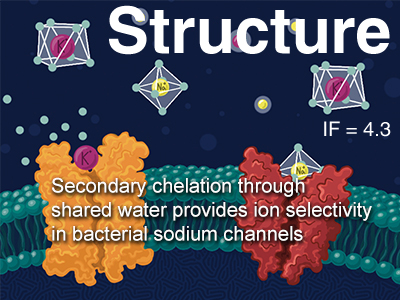
«Secondary Chelation» Mechanism is Proposed to Explain the Selectivity of Bacterial Sodium Channels
Sodium channels play an important role in nature — for example, they determine the excitability of the nervous system and muscles. Their selective conductivity has been intensively studied for many decades, but its physicochemical basis is still unclear. In a new theoretical paper, scientists from the Institute of Bioorganic Chemistry have proposed the so-called “secondary chelation” mechanism, in which the spatial organization of water molecules in the hydration shell of the ion plays a key role. The selectivity filter of a bacterial sodium channel is designed to optimally interact with the hydration shell of Na+, while the shell of K+ is forced to “shrink”, which prevents its passage. The work was published in the journal Structure and was also awarded an illustration on the cover of the issue. Learn more
august 8, 2025