Лаборатория рентгеноструктурного анализа

Руководитель: Плетнёв Владимир Захарович, д. х. н.
+7 (495) 330-75-10 · pletnev@ibch.ru

Рентгеноструктурный анализ, кристаллография белков, пространственная структура, структурно-функциональная взаимосвязь


Лаборатория рентгеноструктурного анализа была образована в 1990 г. на базе соответствующей группы, функционировавшей с 1972 г.


foto_lab_site.jpg

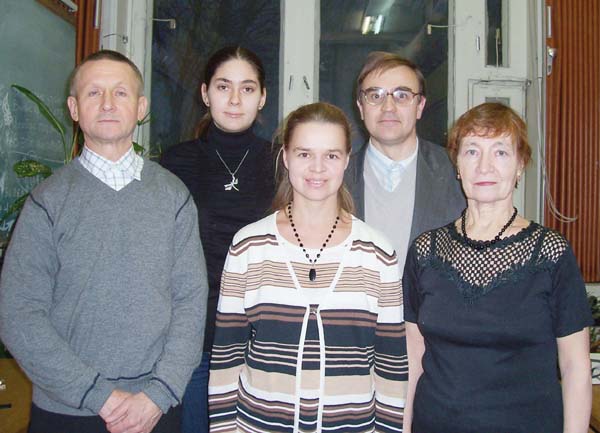
Сотрудники Лаборатории рентгеноструктурного анализа

Направления исследований


Лаборатория занимается исследованиями пространственной структуры и структурно-функциональной взаимосвязи соединений пептидно-белковой природы методами рентгеноструктурного анализа высокого разрешения, методами молекулярной механики/динамики/графики и биоинформатики. Большáя группа исследованных в разное время молекулярных объектов включала цикличские депсипептидные ионофоры, протеазы, углеводсвязывающие белки, антитела, дегидрогеназы и другие ферменты различной функциональной природы, флуоресцентные белки из морских организмов и т. д.

Основные достижения


Пространственная структура большой группы циклических депсипептидных ионофоров, отличающихся размерами цикла, природой и конфигурацией остатков позволила установить важные детали, касающиеся специфичности связывания ионов металлов и механизма их транспорта через биологические мембраны.

Исследования белков различной функциональной природы ведутся с акцентом на структурно-функциональные аспекты специфичности узнавания и связывания лигандов/субстратов. Совместно с Медицинским Исследовательским Институтом имени Хауптмана-Вудвард (Буффало, США) выполнена серия работ под общим названием «Рациональная протеомика семейства короткоцепочечных дегидрогеназ». Для этого семейства был разработан подход для идентификации трехмерной совокупности остатков («отпечатки пальцев»), ответственных за формирование трехмерной структуры белка, связывание кофакторов и субстратов.

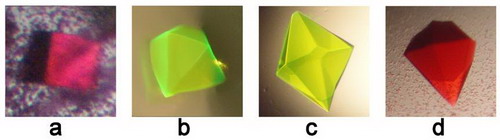
Рисунок 1. Кристаллы флуоресцентных белков: «красного» zRFP574 дикого типа (a), «зеленого» zGFP506 дикого типа (b) и мутантного варианта zGFP506_N66D в переходной «зёленой» (c) и зрелой «красной» (d) формах.

В настоящее время в лаборатории большое внимание уделяется структурным исследованиям флуоресцентных белков (ФБ), используемых в клеточной биологии, биотехнологии и биомедицине в качестве молекулярных бионаномаркеров для визуализации внутренних биологических процессов в клетках или целом организме. Пространственная организация этих белков представляет собой β-цилиндр построенный из 11 β-тяжей, связанных водородными связями. Расположенная в центре цилиндра хромофорная система вместе с ближайшим аминокислотным окружением отвечает за наблюдаемые фотофизические свойства объекта. В нашей лаборатории методом рентгеноструктурного анализа высокого разрешения установлена пространственная структура большой серии ФБ с эмиссией в зеленой, желтой, красной и дальне-красной спектральных областях. Последующий анализ структурно функциональной взаимосвязи исследуемых объектов позволил объяснить многие экспериментально наблюдаемые свойства и сконструировать новые мутантные флуоресцентные варианты с улучшенными фотофизическими характеристиками.
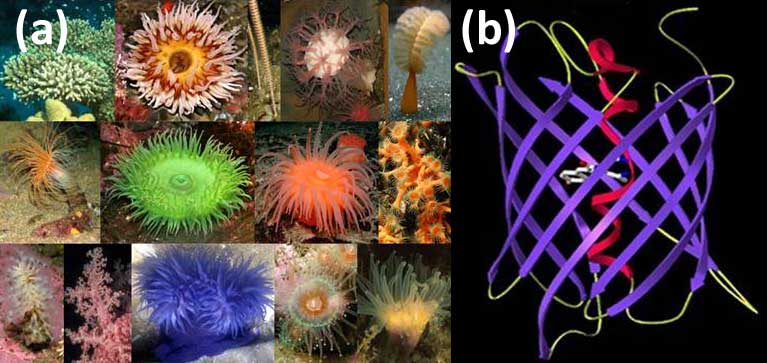
Рисунок 2. Отдельные разновидности морских бутончатых полипов — источников флуоресцентных белков (ФБ) (a); Структурная организация ФБ представляет собой β-цилиндр сформированный из 11 β-тяжей. Вдоль оси цилиндра проходит a-спираль, в центре которой располагается хромофор, образованный из 3-х остатков в результате посттрансляционной модификции (b).
Для хромофора красного ФБ zRFP574 (Zoanthus) была установлена новая ранее неизвестная форма, в которой боковая цепь первого остатка Asp66 хромофоробразующей последовательности претерпевает декарбоксилирование в процессе посттрансляционной модификации.

Структурные исследования дальне-красного мономерного белка mKate показали, что наблюдаемая у него необычная рН зависимость флуоресценции является следствием цис-транс изомеризации внутреннего хромофора. На основе анализа пространственной структуры mKate был предсказан и рациональным способом сконструирован новый генно-инженерный вариант mKate_S158A с почти вдвое улучшенной яркостью. В настоящее время фотофизические характеристики полученного варианта существенно превосходят аналогичные параметры всех известных флуоресцентных мономерных биомаркеров.

Изучение структуры высокотоксичного красного флуоресцентного белка KillerRed позволило установить в окружении хромофора аминокислотные остатки, инициирующие цепь реакций вызывающих токсический эффект. Также, анализ стереохимической композиции на межсубъединичных контактных поверхностях (интерфейсах) в димерных и тетрамерных структурах ФБ позволил идентифицировать ключевые остатки ответственные за нежелательную олигомеризацию.


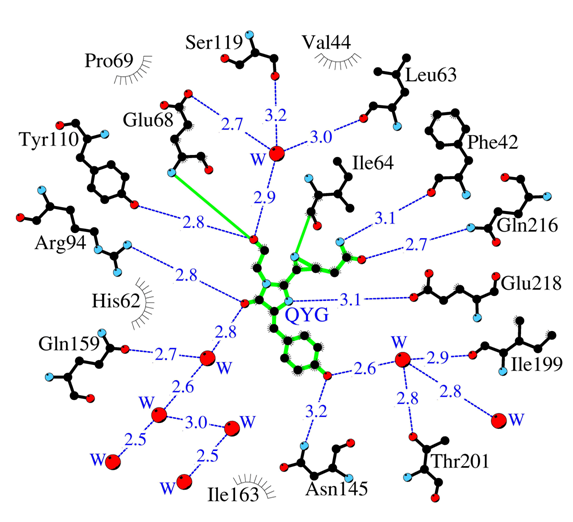
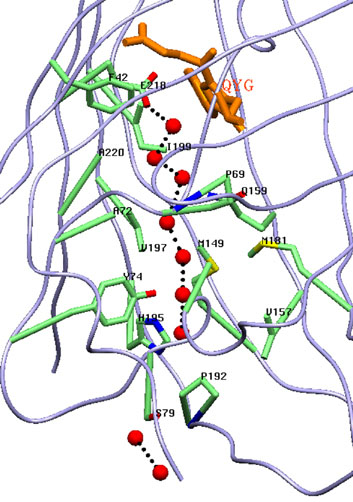
Рисунок 3. Аминокислотное окружение внутреннего хромофора сильно токсичного красного флюоресцентного белка KillerRed. Водородные связи (≤3.3 Å) показаны синими штриховыми линиями, молекулы воды (W) красными шариками и ван дер Ваальсовы контакты (≤3.9 Å) — черными «ресничками».

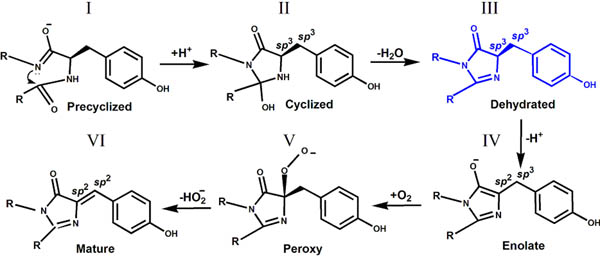
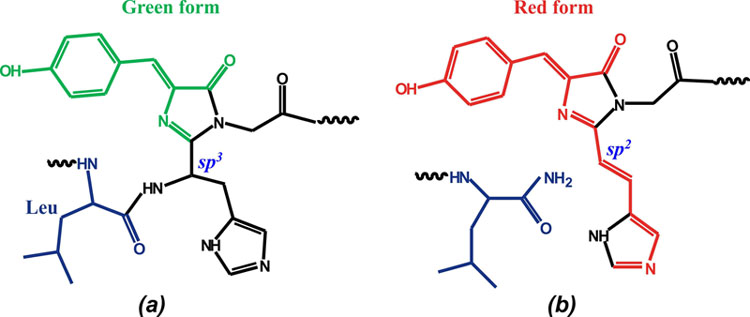
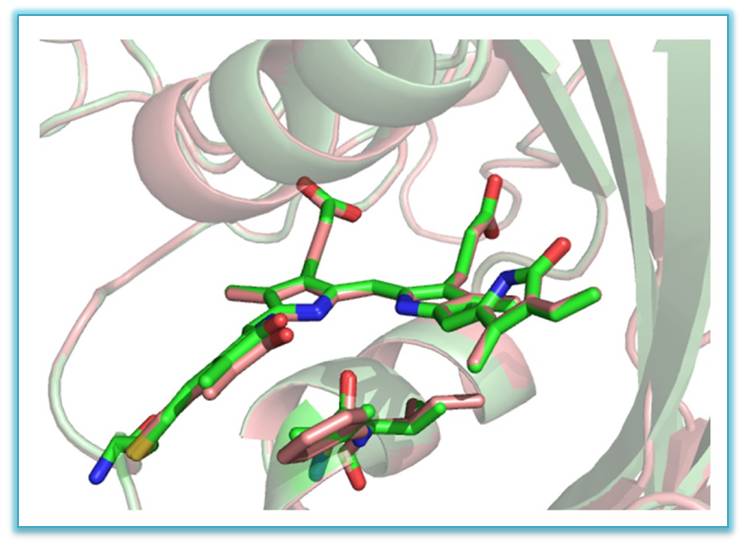
Промежуточная форма биосинтеза хромофора была обнаружена в кристаллической структуре бесцветного нефлуоресцентного ФБ, aceGFP-G222E. Эта впервые экспериментально наблюдаемая структура незрелого хромофора, характеризуемая некопланарным расположением имидазолонового и фенольного циклов, где циклизация основной цепи уже осуществилась, однако Tyr66 все еще остается в нативном неокисленном состоянии с Cα and Cβ атомами в sp3 гибридизации.


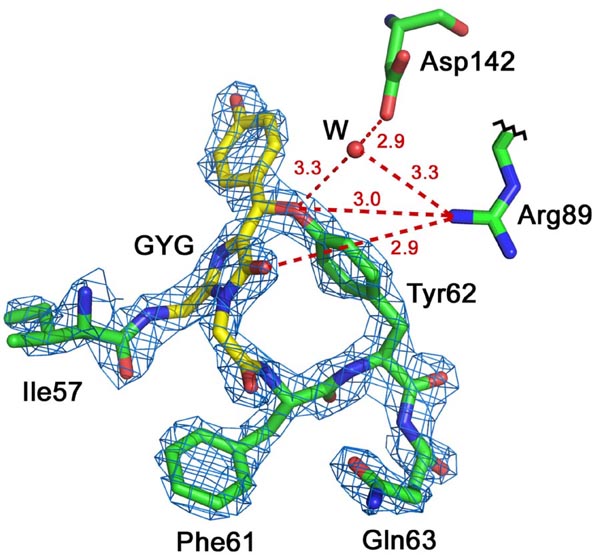
Рисунок 4. Фронтальное и боковое изображения непланарного хромофора (в электронной плотности) нефлуоресцентного aceGFP-G222E в промежуточном состоянии биосинтеза, демонстрирующие тетраэдрическое расположение связей вокруг Cα и Cβ атомов остатка Tyr66 в sp3 гибридизации.

Рисунок 5. Промежуточное состояние (форма III) биосинтеза GFP хромофора в кристаллической структуре aceGFP-G222E

Полученные результаты составили необходимую структурную основу для последующего рационального дизайна более совершенных мономерных биомаркеров для практического применения.


Ф.И.О.ДолжностьЭл. почта
Артемьев Игорь Владимировичн.с.
Архипова Светлана Федоровнан.с.
Горячева Екатерина Александровна, к. б. н.н.с.
Суслова Екатерина Андреевна, к. б. н.н.с.

Избранные публикации

  1. Pletneva N.V., Pletnev V.Z., Lukyanov K.A., Gurskaya N.G., Goryacheva E.A., Martynov V.I., Wlodawer A., Dauter Z., Pletnev S. (2010). Structural evidence for a dehydrated intermediate in green fluorescent protein chromophore biosynthesis. J. Biol. Chem. 285 (21), 15978–84 [+]

    The acGFPL is the first-identified member of a novel, colorless and non-fluorescent group of green fluorescent protein (GFP)-like proteins. Its mutant aceGFP, with Gly replacing the invariant catalytic Glu-222, demonstrates a relatively fast maturation rate and bright green fluorescence (lambda(ex) = 480 nm, lambda(em) = 505 nm). The reverse G222E single mutation in aceGFP results in the immature, colorless variant aceGFP-G222E, which undergoes irreversible photoconversion to a green fluorescent state under UV light exposure. Here we present a high resolution crystallographic study of aceGFP and aceGFP-G222E in the immature and UV-photoconverted states. A unique and striking feature of the colorless aceGFP-G222E structure is the chromophore in the trapped intermediate state, where cyclization of the protein backbone has occurred, but Tyr-66 still stays in the native, non-oxidized form, with C(alpha) and C(beta) atoms in the sp(3) hybridization. This experimentally observed immature aceGFP-G222E structure, characterized by the non-coplanar arrangement of the imidazolone and phenolic rings, has been attributed to one of the intermediate states in the GFP chromophore biosynthesis. The UV irradiation (lambda = 250-300 nm) of aceGFP-G222E drives the chromophore maturation further to a green fluorescent state, characterized by the conventional coplanar bicyclic structure with the oxidized double Tyr-66 C(alpha)=C(beta) bond and the conjugated system of pi-electrons. Structure-based site-directed mutagenesis has revealed a critical role of the proximal Tyr-220 in the observed effects. In particular, an alternative reaction pathway via Tyr-220 rather than conventional wild type Glu-222 has been proposed for aceGFP maturation.

  2. Pletnev S., Gurskaya N.G., Pletneva N.V., Lukyanov K.A., Chudakov D.M., Martynov V.I., Popov V.O., Kovalchuk M.V., Wlodawer A., Dauter Z., Pletnev V. (2009). Structural basis for phototoxicity of the genetically encoded photosensitizer KillerRed. J. Biol. Chem. 284 (46), 32028–39 [+]

    KillerRed is the only known fluorescent protein that demonstrates notable phototoxicity, exceeding that of the other green and red fluorescent proteins by at least 1,000-fold. KillerRed could serve as an instrument to inactivate target proteins or to kill cell populations in photodynamic therapy. However, the nature of KillerRed phototoxicity has remained unclear, impeding the development of more phototoxic variants. Here we present the results of a high resolution crystallographic study of KillerRed in the active fluorescent and in the photobleached non-fluorescent states. A unique and striking feature of the structure is a water-filled channel reaching the chromophore area from the end cap of the beta-barrel that is probably one of the key structural features responsible for phototoxicity. A study of the structure-function relationship of KillerRed, supported by structure-based, site-directed mutagenesis, has also revealed the key residues most likely responsible for the phototoxic effect. In particular, Glu(68) and Ser(119), located adjacent to the chromophore, have been assigned as the primary trigger of the reaction chain.

  3. Pletnev S., Shcherbo D., Chudakov D.M., Pletneva N., Merzlyak E.M., Wlodawer A., Dauter Z., Pletnev V. (2008). A crystallographic study of bright far-red fluorescent protein mKate reveals pH-induced cis-trans isomerization of the chromophore. J. Biol. Chem. 283 (43), 28980–7 [+]

    Была получена кристаллическая структура разработанного нами ранее дальне-красного мономерного белка mKate. Структура решена при различных значениях pH и показано, что хромофор претерпевает цис-транс изомеризацию при понижении значения pH. Эти данные важны для дальнейшей разработки pH-устойчивых и, напротив, pH-зависимых вариантов красных флуоресцентных белков (совместно с лабораторией Рентгеноструктурного анализа ИБХ РАН).

  4. Pletneva N., Pletnev V., Tikhonova T., Pakhomov A.A., Popov V., Martynov V.I., Wlodawer A., Dauter Z., Pletnev S. (2007). Refined crystal structures of red and green fluorescent proteins from the button polyp Zoanthus. Acta Crystallogr. D Biol. Crystallogr. 63 (Pt 10), 1082–93 [+]

    Определена кристаллическая структура белка z2FP574 и его мутантов на различных стадиях созревания. Сделаны выводы, касающиеся структурных основ зелено-красного превращения флуоресценции z2FP574 из Zoanthus sp. 2.

  5. Pletnev V.Z., Thomas J.L., Rhaney F.L., Holt L.S., Scaccia L.A., Umland T.C., Duax W.L. (2006). Rational proteomics V: structure-based mutagenesis has revealed key residues responsible for substrate recognition and catalysis by the dehydrogenase and isomerase activities in human 3beta-hydroxysteroid dehydrogenase/isomerase type 1. J. Steroid Biochem. Mol. Biol. 101 (1), 50–60 [+]

    Mammalian 3beta-hydroxysteroid dehydrogenase/isomerase (3beta-HSD) is a member of the short chain dehydrogenase/reductase. It is a key steroidogenic enzyme that catalyzes the first step of the multienzyme pathway conversion of circulating dehydroepiandrosterone and pregnenolone to active steroid hormones. A three dimensional model of a ternary complex of human 3beta-HSD type 1 (3beta-HSD_1) with an NAD cofactor and androstenedione product has been developed based upon X-ray structures of the ternary complex of E. coli UDP-galactose 4-epimerase (UDPGE) with an NAD cofactor and substrate (PDB_AC: 1NAH) and the ternary complex of human type 1 17beta-hydroxysteroid dehydrogenase (17beta-HSD_1) with an NADP cofactor and androstenedione (PDB_AC: 1QYX). The dimeric structure of the enzyme was built from two monomer models of 3beta-HSD_1 by respective 3D superposition with A and B subunits of the dimeric structure of Streptococcus suis DTDP-D-glucose 4,6-dehydratase (PDB_AC: 1KEP). The 3D model structure of 3beta-HSD_1 has been successfully used for the rational design of mutagenic experiments to further elucidate the key substrate binding residues in the active site as well as the basis for dual function of the 3beta-HSD_1 enzyme. The structure based mutant enzymes, Asn100Ser, Asn100Ala, Glu126Leu, His232Ala, Ser322Ala and Asn323Leu, have been constructed and functionally characterized. The mutagenic experiments have confirmed the predicted roles of the His232 and Asn323 residues in recognition of the 17-keto group of the substrate and identified Asn100 and Glu126 residues as key residues that participate for the dehydrogenase and isomerization reactions, respectively.

  6. Afonin P.V., Fokin A.V., Tsygannik I.N., Mikhailova I.Y., Onoprienko L.V., Mikhaleva I.I., Ivanov V.T., Mareeva T.Y., Nesmeyanov V.A., Li N., Pangborn W.A., Duax W.L., Pletnev V.Z. (2001). Crystal structure of an anti-interleukin-2 monoclonal antibody Fab complexed with an antigenic nonapeptide. Protein Sci. 10 (8), 1514–21 [+]

    The three-dimensional structure of the Fab fragment of a monoclonal antibody (LNKB-2) to human interleukin-2 (IL-2) complexed with a synthetic antigenic nonapeptide, Ac-Lys-Pro-Leu-Glu-Glu-Val-Leu-Asn-Leu-OMe, has been determined at 3.0 A resolution. In the structure, four out of the six hypervariable loops of the Fab (complementarity determining regions [CDRs] L1, H1, H2, and H3) are involved in peptide association through hydrogen bonding, salt bridge formation, and hydrophobic interactions. The Tyr residues in the Fab antigen binding site play a major role in antigen-antibody recognition. The structures of the complexed and uncomplexed Fab were compared. In the antigen binding site the CDR-L1 loop of the antibody shows the largest structural changes upon peptide binding. The peptide adopts a mostly alpha-helical conformation similar to that in the epitope fragment 64-72 of the IL-2 antigen. The side chains of residues Leu 66, Val 69, and Leu 70, which are shielded internally in the IL-2 structure, are involved in interactions with the Fab in the complex studied. This indicates that antibody-antigen complexation involves a significant rearrangement of the epitope-containing region of the IL-2 with retention of the alpha-helical character of the epitope fragment.

  7. Pletnev V.Z., Zamolodchikova T.S., Pangborn W.A., Duax W.L. (2000). Crystal structure of bovine duodenase, a serine protease, with dual trypsin and chymotrypsin-like specificities. Proteins 41 (1), 8–16 [+]

    The three-dimensional structure of duodenase, a serine protease from bovine duodenum mucosa, has been determined at 2.4A resolution. The enzyme, which has both trypsin-like and chymotrypsin-like activities, most closely resembles human cathepsin G with which it shares 57% sequence identity and similar specificity. The catalytic Ser195 in duodenase adopts the energetically favored conformation typical of serine proteinases and unlike the strained state typical of lipase/esterases. Of several waters in the active site of duodenase, the one associated with Ser214 is found in all serine proteinases and most lipase/esterases. The conservation of the Ser214 residue in serine proteinase, its presence in the active site, and participation in a hydrogen water network involving the catalytic triad (His57, Asp107, and Ser195) argues for its having an important role in the mechanism of action. It may be referred to as a fourth member of the catalytic triad. Duodenase is one of a growing family of enzymes that possesses trypsin-like and chymotrypsin-like activity. Not long ago, these activities were considered to be mutually exclusive. Computer modeling reveals that the S1 subsite of duodenase has structural features compatible with effective accommodation of P1 residues typical of trypsin (Arg/Lys) and chymotrypsin (Tyr/Phe) substrates. The determination of structural features associated with functional variation in the enzyme family may permit design of enzymes with a specific ratio of trypsin and chymotrypsin activities.

Руководитель подразделения

Плетнёв Владимир Захарович

  • Москва, ул. Миклухо-Маклая, 16/10 — На карте
  • ИБХ РАН, корп. 52, комн. 155
  • Тел.: +7 (495) 330-75-10
  • Эл. почта: pletnev@ibch.ru