


Press-room / news / Science news /
The stepwise mechanism of TRPV6 channel blockade by polyamine spermine
Researchers from IBCh RAS, as part of an international collaboration, have elucidated the mechanism by which the natural polyamine spermine blocks the human calcium channel TRPV6. The study was supported by the Russian Ministry of Science and Higher Education (computational modeling) and published in Nature Communications.
TRPV6 is a highly calcium-selective ion channel that plays a key role in maintaining calcium homeostasis in epithelial tissues, including the intestine, placenta, and pancreas. Loss-of- function mutations in TRPV6 are associated with several hereditary disorders, such as neonatal hyperparathyroidism, chronic pancreatitis, and Crohn’s disease. In contrast, TRPV6 is overexpressed in prostate, breast, and colon cancers, making it a promising target for anticancer therapy.
Spermine is a small endogenous polycation present in virtually all living cells, where it regulates cell growth and proliferation. Although polyamines are known to modulate a variety of ion channels, their structural mode of interaction with TRP channels has remained poorly understood until recently.
In this study, the authors demonstrate that intracellular spermine effectively inhibits TRPV6- mediated currents. Cryo-electron microscopy revealed that spermine binds within the open channel pore, lying along its central axis and extending from the selectivity filter into the central cavity, where it physically occludes ion permeation without inducing significant conformational changes in the channel.
Molecular modeling, including all-atom molecular dynamics simulations, provided atomic-level insight into the blocking process, showing that spermine enters the pore in a stepwise manner, occupying three metastable positions. Initially, spermine associates with the cytoplasmic entrance near residue D580 (Site 1), sampling multiple orientations. It then progresses into the central cavity (Site 2), displacing resident ions, before reaching the selectivity filter (Site 3), where it is stabilized through electrostatic interactions with residues T539 and D542, effectively capping the pore. Site-directed mutagenesis and electrophysiological measurements confirmed the importance of these residues: substitutions T539V and D580R nearly abolished spermine- dependent channel block.
Together, these findings provide detailed mechanistic insight into endogenous regulation of TRPV6. Given that intracellular polyamine concentrations are often elevated in tumors, spermine-mediated channel inhibition may represent a physiologically relevant link between polyamine metabolism and calcium signaling in cancer.
The work was conducted in collaboration with the laboratories of Prof. A. Sobolevsky (Columbia University, New York, USA) and Dr. V. Chubanov (Ludwig Maximilian University of Munich, Germany).
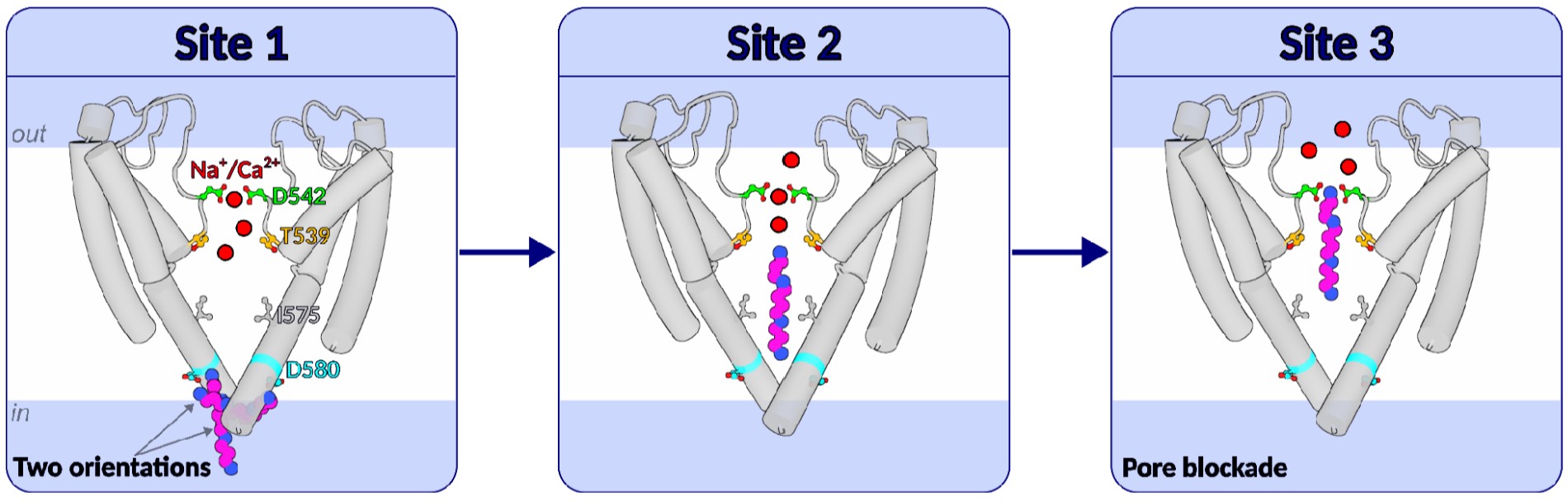
Fig. 1. Stepwise mechanism of TRPV6 pore block by spermine from molecular dynamics simulations. In Site 1, spermine binds near residue D580 at the cytoplasmic pore entrance, sampling two orientations. In Site 2, it advances into the central cavity, displacing resident ions. In Site 3, spermine reaches the selectivity filter and is anchored by contacts with T539 and D542, fully occluding the pore. Spermine is depicted as magenta and blue spheres, Na + /Ca 2+ cations – as red spheres; TRPV6 helices are represented as gray cylinders; residues D580, I575 (gate), T539, and D542 are shown as sticks and colored blue, gray, orange, and green, respectively. Two subunits out of four are shown on each panel; the membrane is indicated in white.
june 3