


Press-room / news / Science news /
Dual-Color Bioluminescent Reporters Enable Quantitative Measurement of Gene Expression Independent of Metabolic Fluctuations
A study by an international team of scientists led by researchers from the Shemyakin–Ovchinnikov Institute of Bioorganic Chemistry of the Russian Academy of Sciences (IBCh RAS) has been published in Nature Plants. The study presents and validates a simple and elegant approach to making autonomous bioluminescent reporters resistant to metabolic fluctuations. The researchers developed pairs of luciferases that use the same substrate but emit light of different colors and demonstrated that the ratio between the two signals reflects reporter gene activity rather than the metabolic state of the cell. This approach enables long- term monitoring of plant hormone signaling and defense responses.
Bioluminescent reporters are widely used to study gene activity in plants, allowing researchers to track changes in gene expression across space and time. Their function is based on the oxidation of luciferin, a reaction catalyzed by the enzyme luciferase and accompanied by light emission. Such reporters typically require an external supply of luciferin.
Previously, researchers from IBCh RAS demonstrated that plants can synthesize luciferin autonomously using enzymes found in bioluminescent fungi. These transgenic plants can emit light without the addition of an external substrate, enabling continuous, long-term monitoring of gene activity.
However, such reporters have a significant limitation: luminescence intensity depends not only on the activity of the gene under investigation but also on the metabolic state of the cell. Consequently, a decrease in brightness may indicate either reduced gene expression or decreased availability of luciferin required for bioluminescence, even when gene activity remains unchanged.
The new study addresses precisely this problem.
The authors' idea was simple: if two luciferases that use the same luciferin substrate but emit light in different spectral regions are expressed simultaneously in the same cell, the ratio of their luminescence intensities will depend primarily on the relative abundance of the two enzymes rather than on substrate concentration or the overall metabolic state of the cell. One luciferase serves as the reporter, with its gene placed under the control of the promoter of interest, while the other serves as a reference, expressed from a constitutive promoter. The ratio of red-to- green signals, known as the ratiometric signal, provides a quantitative measure of promoter activity.
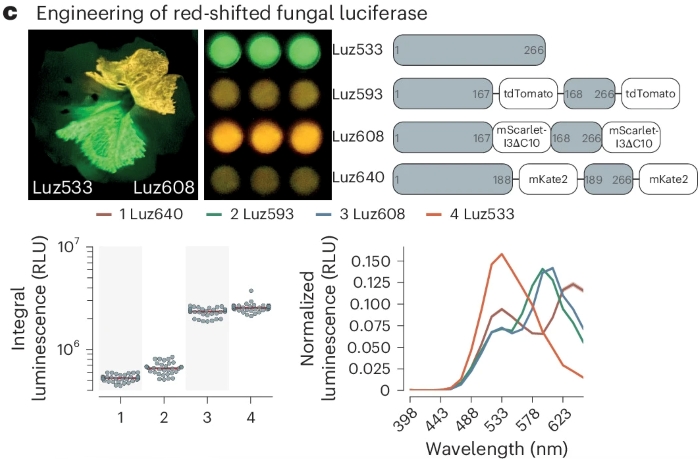
Implementing this strategy required luciferases with emission maxima at different wavelengths but using the same substrate. For the fungal bioluminescence pathway, red-emitting luciferase variants were virtually non-existent. The researchers therefore employed a strategy based on BRET (bioluminescence resonance energy transfer). They inserted fluorescent proteins (tdTomato, mScarlet, and mKate2) into different regions of the luciferase molecule, allowing energy generated during luciferin oxidation to be transferred to a fluorophore and subsequently emitted as red light.
First, the authors systematically scanned the luciferase sequence by inserting and deleting protein fragments to identify positions tolerant of structural modifications. They then combined optimal insertion sites, an improved luciferase variant (Luz533), and optimized linkers to generate three new variants: Luz593, Luz608, and Luz640. All three retained sufficient brightness for imaging and exhibited substantial spectral shifts. Although Luz640 showed the greatest red shift and spectral separation, Luz593 and Luz608 were selected for further experiments because of their higher brightness.
Next, the authors coexpressed green and red luciferases under the control of strong constitutive promoters and treated plant cells with thidiazuron, a synthetic plant growth regulator that alters hormonal balance and metabolism. Under control conditions, luminescence intensity could fluctuate severalfold, whereas the ratio of red-to-green signals remained stable. Finally, experiments were conducted on transgenic Arabidopsis thaliana plants. The authors used a "master line" capable of synthesizing luciferin but lacking luciferase itself. They introduced genetic constructs in which green luciferase expression was controlled by the WRKY70 promoter (involved in salicylic acid signaling) or the ORCA3 promoter (associated with early responses to jasmonic acid), while red luciferase served as the reference.
Three days of continuous imaging of plants carrying the WRKY70 reporter revealed that, despite substantial fluctuations in overall luminescence intensity, the ratio between the two signals remained stable in the absence of salicylic acid pathway inducers. Moreover, the researchers observed "flickering" patterns of immune activity in rosette leaves, which could be tracked using the ratiometric signal. Following treatment with acetylsalicylic acid, the ratiometric signal was consistent with independent measurements of transcriptional activity.
In plants carrying the ORCA3 reporter, the researchers modeled the response to infection by the bacterial pathogen Pseudomonas savastanoi. Ratiometric imaging revealed a localized response around the infection site against a background of brightly glowing leaf veins whose luminescence intensity varied considerably. Without ratiometric correction, such weak localized signals would have been difficult to distinguish.
By separating changes in gene activity from fluctuations in cellular metabolism, dual-color bioluminescent reporters enable quantitative, non-invasive, and long-term monitoring of gene expression in living plants. The developed technology opens new opportunities for studying plant development, phytohormone signaling, and responses to environmental stress and pathogens.
october 29