Laboratory of biomolecular modeling

Department of structural biology

Head: Roman Efremov, D. Sc., professor
+7 (495) 336-20-00 · efremov@nmr.ru

model.nmr.ru

Molecular modelling, molecular hydrophobicity potential, membrane and membrane-active proteins and peptides, structural organization of biological membranes, molecular design, docking, molecular dynamics, computational experiment, structural proteomics, in silico technologies, bioinformatics, transmembrane alpha-helical dimers.

Laboratory of Biomolecular Modeling was created in 2007 on the basis of the former Group of Molecular Modeling. The Laboratory is a part of the Department of Structural Biology. Over a period of 15 years the Laboratory members are carrying research in the field of computer molecular modeling and bioinformatics.

Research directions

The Laboratory conducts research in the field of molecular modeling of biomolecular spatial structure and dynamics. The main specialization of the Laboratory is investigation of structure and function of membrane and membrane-active proteins and peptides, ligand-receptor interactions, as well as rational computer-aided design of novel biologically active compounds, including those acting on targets in biomembranes.

Main part of researches is performed in strong collaboration with experimental groups that provide the maximal efficiency of theoretical studies. All molecular simulations are carried out on modern computational facilities available in the Laboratory (multi-CPU Linux clusters, graphical stations, etc). The Laboratory has access to computational resources of the Joint Supercomputer Center of the Russian Academy of Sciences (Moscow).

Main results

1992—1997. Quantitative characterization and mapping of spatial hydrophobic properties of biomolecules. Such an analysis was done for the first time using the molecular hydrophobicity potential (MHP) approach. МHP-technique was successfully applied to study a number of water-soluble and membrane-bound peptides and proteins, as well as to assess intermolecular interactions in these systems. These approaches were implemented in a web-tool PLATINUM available on the web site of the Laboratory (http://model.nmr.ru/platinum).

1998—2000. A novel implicit membrane model was elaborated. The membrane environment is described by an additional solvation energy term, which scales potential energy of atoms depending on one of their 3D coordinates. The model allows investigation of protein-membrane interactions by Monte Carlo simulations. It is implemented in the program FANMEM – modified version of the FANTOM software (von Freyberg B., W. Braun 1991. J. Comp.Chem. 12:1065–1076).

2000—2004. A series of simulations of different membrane-active proteins and peptides (cardiotoxins, fusion peptides, etc) was performed in the implicit membrane. The crucial factors (amino acid composition, hydrophobic organization, conformational dynamics) determining the membrane binding were delineated.

2005—2008. Explicit full-atom models of lipid bilayers and detergent micelles of different molecular composition were elaborated. These models were used to study interactions of membrane-active peptides of different classes (fusion, antimicrobial, cell-penetrating). The structural organizations of model membranes were also investigated. Lipid composition, structural and dynamic properties of peptides were shown to play significant role in destabilization of the membrane. For several antimicrobial peptides from Lachesana tarabaevi spider venom important structure-function relationships were delineated. Based on these data, several new antimicrobial peptides with predefined activities were designed.

2004—2008. Domain motions of protein-target and hydrophobic interactions in molecular docking. We developed an original method to estimate ligand-receptor hydrophobic match and adenine-specific scoring functions based on this method. Modeling of ATP binding to P-type ATPases demonstrated that these scores were particularly efficient when ligand binding was accompanied by large scale domain motions of enzymes. These approaches were implemented in a web-tool PLATINUM available on the web site of our Laboratory (http://model.nmr.ru/platinum).

2006—2008. New approaches in modeling of transmembrane α-helical dimers were elaborated. 3D structures of the dimers formed by transmembrane fragments of several proteins (glycophorin A, receptor tyrosine kinases) were obtained using Monte Carlo simulations in the implicit hydrophobic slabs mimicking hydrophobic lipid bilayer. This was done using the FANMEM software. Full-atom membrane models were used to model transmembrane helical dimer of the pro-apoptotic protein Bnip3. These simulations were carried out with a set of NMR-derived structural restrains.

2006—2008. A method for assessment of packing quality of spatial models of α-helical membrane proteins. Scoring functions were designed to validate the theоretical 3D models of G-protein coupled receptors. The method efficiently identifies the native-like (e.g., closest to X-ray) model among large number of misleading folds.

Results of studies in the Laboratory were confirmed by several Russian patents.
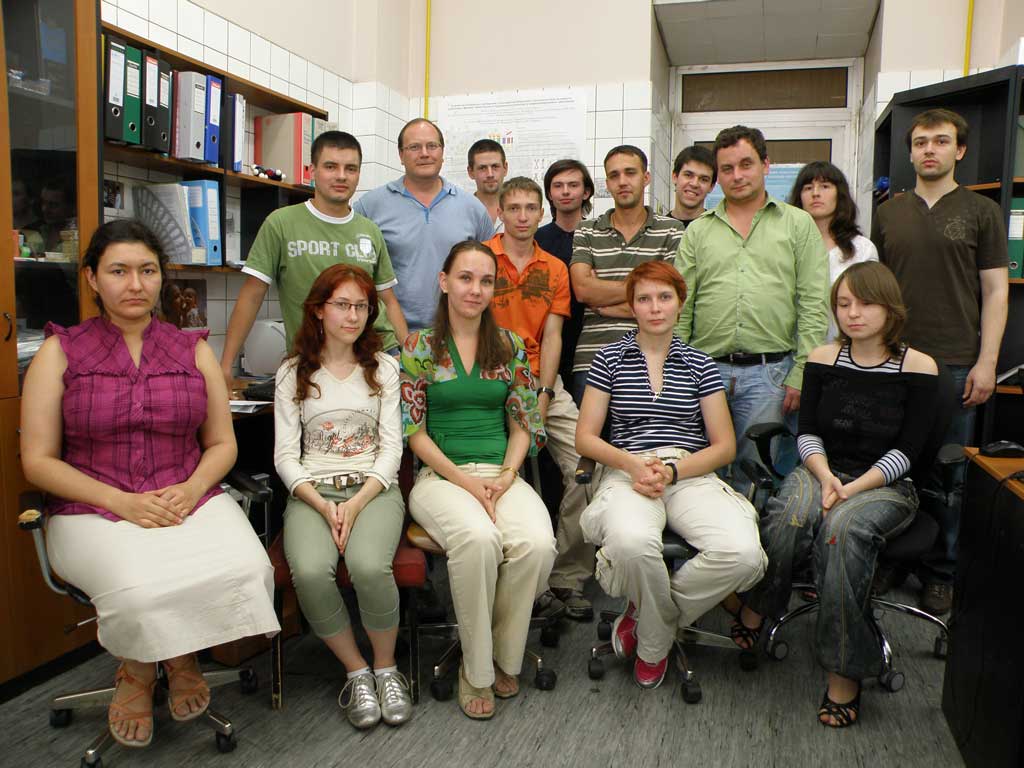
Laboratory of biomolecular modeling. In the first row (left to right): st. Vahrutdinova G.N., Balitskaya E.D., Tarasova N.K., Ph.D. st. Pyrkova D.V., st. Ivanova I.D. In the second row: Ph.D. Chugunov A.O., head of the lab D.Sc. Efremov R.G., Ph.D. Pyrkov T.V., Ph.D. Polyansky A.A., Ph.D. Volynsky P.E. In the last row: Ph.D. st. Novoseletsky V.N., st. Kuznecov A.S., Ozerov I.V., j.r.a. Konshina A.G., st. Popov P.A.
NamePositionE-mail
. 776PhD stud.
Alexander S. Arseniev, d. sc., professordept. head
Anton O. Chugunov, ph. d.r. f.
Anastasija G. Konshinaj. r. f.
Dmitry E. Nolde, ph. d.s. r. f.
Anton A. Polyanskij, ph. d.r. f.
Darya V. PyrkovaPhD stud.
Pavel E. Volynsky, ph. d.s. r. f.

Selected publications

  1. Chugunov A.O., Simms J., Poyner D.R., Dehouck Y., Rooman M., Gilis D., Langer I. (2010). Evidence that interaction between conserved residues in transmembrane helices 2, 3, and 7 are crucial for human VPAC1 receptor activation. Mol. Pharmacol. 78 (3), 394–401 [+]

    The VPAC(1) receptor belongs to family B of G protein-coupled receptors (GPCR-B) and is activated upon binding of the vasoactive intestinal peptide (VIP). Despite the recent determination of the structure of the N terminus of several members of this receptor family, little is known about the structure of the transmembrane (TM) region and about the molecular mechanisms leading to activation. In the present study, we designed a new structural model of the TM domain and combined it with experimental mutagenesis experiments to investigate the interaction network that governs ligand binding and receptor activation. Our results suggest that this network involves the cluster of residues Arg(188) in TM2, Gln(380) in TM7, and Asn(229) in TM3. This cluster is expected to be altered upon VIP binding, because Arg(188) has been shown previously to interact with Asp(3) of VIP. Several point mutations at positions 188, 229, and 380 were experimentally characterized and were shown to severely affect VIP binding and/or VIP-mediated cAMP production. Double mutants built from reciprocal residue exchanges exhibit strong cooperative or anticooperative effects, thereby indicating the spatial proximity of residues Arg(188), Gln(380), and Asn(229). Because these residues are highly conserved in the GPCR-B family, they can moreover be expected to have a general role in mediating function.

  2. Bocharov E.V., Mayzel M.L., Volynsky P.E., Mineev K.S., Tkach E.N., Ermolyuk Y.S., Schulga A.A., Efremov R.G., Arseniev A.S. (2010). Left-handed dimer of EphA2 transmembrane domain: Helix packing diversity among receptor tyrosine kinases. Biophys. J. 98 (5), 881–9 [+]

    The Eph receptor tyrosine kinases and their membrane-bound ephrin ligands control a diverse array of cell-cell interactions in the developing and adult organisms. During signal transduction across plasma membrane, Eph receptors, like other receptor tyrosine kinases, are involved in lateral dimerization and subsequent oligomerization presumably with proper assembly of their single-span transmembrane domains. Spatial structure of dimeric transmembrane domain of EphA2 receptor embedded into lipid bicelle was obtained by solution NMR, showing a left-handed parallel packing of the transmembrane helices (535-559)(2). The helices interact through the extended heptad repeat motif L(535)X(3)G(539)X(2)A(542)X(3)V(546)X(2)L(549) assisted by intermolecular stacking interactions of aromatic rings of (FF(557))(2), whereas the characteristic tandem GG4-like motif A(536)X(3)G(540)X(3)G(544) is not used, enabling another mode of helix-helix association. Importantly, a similar motif AX(3)GX(3)G as was found is responsible for right-handed dimerization of transmembrane domain of the EphA1 receptor. These findings serve as an instructive example of the diversity of transmembrane domain formation within the same family of protein kinases and seem to favor the assumption that the so-called rotation-coupled activation mechanism may take place during the Eph receptor signaling. A possible role of membrane lipid rafts in relation to Eph transmembrane domain oligomerization and Eph signal transduction was also discussed.

  3. Volynsky P.E., Mineeva E.A., Goncharuk M.V., Ermolyuk Y.S., Arseniev A.S., Efremov R.G. (2010). Computer simulations and modeling-assisted ToxR screening in deciphering 3D structures of transmembrane alpha-helical dimers: ephrin receptor A1. Phys Biol 7, 16014 [+]

    Membrane-spanning segments of numerous proteins (e.g. receptor tyrosine kinases) represent a novel class of pharmacologically important targets, whose activity can be modulated by specially designed artificial peptides, the so-called interceptors. Rational construction of such peptides requires understanding of the main factors driving peptide-peptide association in lipid membranes. Here we present a new method for rapid prediction of the spatial structure of transmembrane (TM) helix-helix complexes. It is based on computer simulations in membrane-like media and subsequent refinement/validation of the results using experimental studies of TM helix dimerization in a bacterial membrane by means of the ToxR system. The approach was applied to TM fragments of the ephrin receptor A1 (EphA1). A set of spatial structures of the dimer was proposed based on Monte Carlo simulations in an implicit membrane followed by molecular dynamics relaxation in an explicit lipid bilayer. The resulting models were employed for rational design of wild-type and mutant genetic constructions for ToxR assays. The computational and the experimental data are self-consistent and provide an unambiguous spatial model of the TM dimer of EphA1. The results of this work can be further used to develop new biologically active 'peptide interceptors' specifically targeting membrane domains of proteins.

  4. Чугунов А.О., Ефремов Р.Г. (2009). Предсказание пространственной структуры белков: акцент на мембранных мишенях. Биоорг. хим. 35 (6), 1–17 [+]

    Интегральные белки биологических мембран — объекты, пространственная структура которых с большим трудом поддаётся экспериментальному определению. Во многих случаях существует возможность теоретического предсказания строения белковых молекул, используя физические или эмпирические закономерности. В обзоре рассмотрены основные существующие приёмы предсказания пространственной структуры белков с использованием компьютерных алгоритмов; основной акцент сделан на наиболее «сложные» объекты — мембранных белки (МБ).

    Отдельно описаны идеология “de novo”-предсказаний, основывающаяся на эмпирических физических закономерностях, и подход сопоставительного моделирования (или моделирования на основании гомологии), в котором используется информация о трёхмерном строении родственных белков. В качестве примеров рассмотрены фармакологически важные классы G-белоксопряжённых рецепторов, рецепторных тирозинкиназ и другие МБ. Обсуждаются потенциальные сферы применения моделей белков и существующие подходы к оценке «качества» упаковки полипептидной цепи в моделях.

  5. Pyrkov T.V., Chugunov A.O., Krylov N.A., Nolde D.E., Efremov R.G. (2009). PLATINUM: a web tool for analysis of hydrophobic/hydrophilic organization of biomolecular complexes. Bioinformatics 25 (9), 1201–2 [+]

    The PLATINUM (Protein-Ligand ATtractions Investigation NUMerically) web service is designed for analysis and visualization of hydrophobic/hydrophilic properties of biomolecules supplied as 3D-structures. Furthermore, PLATINUM provides a number of tools for quantitative characterization of the hydrophobic/hydrophilic match in biomolecular complexes e.g. in docking poses. These complement standard scoring functions. The calculations are based on the concept of empirical Molecular Hydrophobicity Potential (MHP). AVAILABILITY: The PLATINUM web tool as well as detailed documentation and tutorial are available free of charge for academic users at http://model.nmr.ru/platinum/. PLATINUM requires Java 5 or higher and Adobe Flash Player 9. SUPPLEMENTARY INFORMATION: Supplementary data are available at Bioinformatics online.

  6. Polyansky A.A., Volynsky P.E., Arseniev A.S., Efremov R.G. (2009). Adaptation of a membrane-active peptide to heterogeneous environment. I. Structural plasticity of the peptide. The journal of physical chemistry. B 113 (4), 1107–19 [+]

    A detailed study of different factors determining interaction of a membrane-active peptide (a cell-penetrating peptide — penetratin) is presented. It concerns the role of conformational plasticity of the peptide in different membrane environment, as well as the ability of the peptide to form stable specific residue-residue interactions and make contacts with particular lipids.

  7. Polyansky A.A., Volynsky P.E., Arseniev A.S., Efremov R.G. (2009). Adaptation of a membrane-active peptide to heterogeneous environment. II. The role of mosaic nature of the membrane surface. The journal of physical chemistry. B 113 (4), 1120–6 [+]

    This study postulates the mosaic hydrophobic-hydrophilic organization of the lipid membrane surface. Special attention is given to the influence of such heterogeneous polar properties of the water-lipid interface on the binding mode of membrane-active agents (a case study of cell-penetrating peptide — penetratin).

  8. Farce A., Chugunov A.O., Logé C., Sabaouni A., Yous S., Dilly S., Renault N., Vergoten G., Efremov R.G., Lesieur D., Chavatte P. (2008). Homology modeling of MT1 and MT2 receptors. European journal of medicinal chemistry 43 (9), 1926–44 [+]

    Melatonin is a neurohormone synthesized and secreted mainly during the dark period of the circadian cycle by the pineal gland. It has already been proved to be involved in a number of chronobiological processes, most of them being mediated by its membranar receptors MT1 and MT2. Both are members of the GPCR class and, despite the interest they elicit, their 3D structure is still to be described. Models for both human MT1 and MT2 receptors have been constructed by homology modeling, using the X-ray structure of bovine rhodopsin as template. These models have been evaluated in terms of hydrophobic properties of the helices and refined to take into account the rearrangement of GPCRs necessary for their activation, thus leading to a putative activated model for each subtype.

  9. Dubovskii P.V., Volynsky P.E., Polyansky A.A., Karpunin D.V., Chupin V.V., Efremov R.G., Arseniev A.S. (2008). Three-dimensional structure/hydrophobicity of latarcins specifies their mode of membrane activity. Biochemistry 47 (11), 3525–33 [+]

    Latarcins, linear peptides from the Lachesana tarabaevi spider venom, exhibit a broad-spectrum antimicrobial activity, likely acting on the bacterial cytoplasmic membrane. We study their spatial structures and interaction with model membranes by a combination of experimental and theoretical methods to reveal the structure-activity relationship. In this work, a 26 amino acid peptide, Ltc1, was investigated. Its spatial structure in detergent micelles was determined by (1)H nuclear magnetic resonance (NMR) and refined by Monte Carlo simulations in an implicit water-octanol slab. The Ltc1 molecule was found to form a straight uninterrupted amphiphilic helix comprising 8-23 residues. A dye-leakage fluorescent assay and (31)P NMR spectroscopy established that the peptide does not induce the release of fluorescent marker nor deteriorate the bilayer structure of the membranes. The voltage-clamp technique showed that Ltc1 induces the current fluctuations through planar membranes when the sign of the applied potential coincides with the one across the bacterial inner membrane. This implies that Ltc1 acts on the membranes via a specific mechanism, which is different from the carpet mode demonstrated by another latarcin, Ltc2a, featuring a helix-hinge-helix structure with a hydrophobicity gradient along the peptide chain. In contrast, the hydrophobic surface of the Ltc1 helix is narrow-shaped and extends with no gradient along the axis. We have also disclosed a number of peptides, structurally homologous to Ltc1 and exhibiting similar membrane activity. This indicates that the hydrophobic pattern of the Ltc1 helix and related antimicrobial peptides specifies their activity mechanism. The latter assumes the formation of variable-sized lesions, which depend upon the potential across the membrane.

  10. Bocharov E.V., Mineev K.S., Volynsky P.E., Ermolyuk Y.S., Tkach E.N., Sobol A.G., Chupin V.V., Kirpichnikov M.P., Efremov R.G., Arseniev A.S. (2008). Spatial structure of the dimeric transmembrane domain of the growth factor receptor ErbB2 presumably corresponding to the receptor active state. J. Biol. Chem. 283 (11), 6950–6 [+]

    Proper lateral dimerization of the transmembrane domains of receptor tyrosine kinases is required for biochemical signal transduction across the plasma membrane. The spatial structure of the dimeric transmembrane domain of the growth factor receptor ErbB2 embedded into lipid bicelles was obtained by solution NMR, followed by molecular dynamics relaxation in an explicit lipid bilayer. ErbB2 transmembrane segments associate in a right-handed alpha-helical bundle through the N-terminal tandem GG4-like motif Thr652-X3-Ser656-X3-Gly660, providing an explanation for the pathogenic power of some oncogenic mutations.

  11. Vereshaga Y.A., Volynsky P.E., Pustovalova J.E., Nolde D.E., Arseniev A.S., Efremov R.G. (2007). Specificity of helix packing in transmembrane dimer of the cell death factor BNIP3: a molecular modeling study. Proteins 69 (2), 309–25 [+]

    A computational technique for prediction of the spatial structure of transmembrane alpha-helical dimers is proposed. The approach is based on Monte Carlo simulations in the space of dihedral angles in the presence of the implicit membrane. Validity of the method was demonstrated with the example of transmembrane domain of mitochondrial pro-apoptotic protein BNIP3.

  12. Efremov R.G., Volynsky P.E., Nolde D.E., Vergoten G., Arseniev A.S. (2007). The membrane-proximal fusion domain of HIV-1 GP41 reveals sequence-specific and fine-tuning mechanism of membrane binding. J. Biomol. Struct. Dyn. 25 (2), 195–205 [+]

    The membrane interface-partitioning region preceding the transmembrane anchor of the human immunodeficiency virus type 1 (HIV-1) gp41 envelope protein is one of the sites responsible for virus binding to its host cell membrane and subsequent fusion events. Here, we used molecular modeling techniques to assess membrane interactions, structure, and hydrophobic properties of the fusion-active peptide representing this region, several of its homologs from different HIV-1 strains, as well as a peptide - defective gp41 phenotype - unable to mediate cell-cell fusion and virus entry. It is shown that the wild-type peptides bind to the water-membrane interface in alpha-helical conformation, while the mutant adopts partly destabilized helix-break-helix structure on the membrane surface. The wild-type peptides reveal specific "tilted oblique-oriented" pattern of hydrophobicity on their surfaces - the property specific for fusion regions of other viruses. Fusion peptides penetrate into the membrane with their N-termini and reveal "fine-tuning" interactions with membrane and water environments: the shift of this balance (e.g., due to point mutations) may dramatically change the mode of membrane binding, and therefore, may cause loss of fusion activity. The modeling results agree well with experimental data and provide a strategy to delineate fusogenic regions in amino acid sequences of viral proteins.

  13. Chugunov A.O., Novoseletsky V.N., Nolde D.E., Arseniev A.S., Efremov R.G. (2007). Method to assess packing quality of transmembrane alpha-helices in proteins. 1. Parametrization using structural data. Journal of chemical information and modeling 47 (3), 1150–62 [+]

    Integral membrane proteins (MPs) are pharmaceutical targets of exceptional importance. Modern methods of three-dimensional protein structure determination often fail to supply the fast growing field of structure-based drug design with the requested MPs' structures. That is why computational modeling techniques gain a special importance for these objects. Among the principal difficulties limiting application of these methods is the low quality of the MPs' models built in silico. In this series of two papers we present a computational approach to the assessment of the packing "quality" of transmembrane (TM) alpha-helical domains in proteins. The method is based on the concept of protein environment classes, whereby each amino acid residue is described in terms of its environment polarity and accessibility to the membrane. In the first paper we analyze a nonredundant set of 26 TM alpha-helical domains and compute the residues' propensities to five predefined classes of membrane-protein environments. Here we evaluate the proposed approach only by various test sets, cross-validation protocols and ability of the method to delimit the crystal structure of visual rhodopsin, and a number of its erroneous theoretical models. More advanced validation of the method is given in the second article of this series. We assume that the developed "membrane score" method will be helpful in optimizing computer models of TM domains of MPs, especially G-protein coupled receptors.

  14. Chugunov A.O., Novoseletsky V.N., Nolde D.E., Arseniev A.S., Efremov R.G. (2007). Method to assess packing quality of transmembrane alpha-helices in proteins. 2. Validation by "correct vs misleading" test. Journal of chemical information and modeling 47 (3), 1163–70 [+]

    We describe a set of tests designed to check the ability of the new "membrane score" method (see the first paper of this series) to assess the packing quality of transmembrane (TM) alpha-helical domains in proteins. The following issues were addressed: (1) Whether there is a relation between the score (S(mem)) of a model and its closeness to the "nativelike" conformation? (2) Is it possible to recognize a correct model among misfolded and erroneous ones? (3) To what extent the score of a homology-built model is sensitive to errors in sequence alignment? To answer the first question, two test cases were considered: (i) Several models of bovine aquaporin-1 (target protein) were built on the structural templates provided by its homologs with known X-ray structure. (ii) Side chains in the spatial models of visual rhodopsin and cytochrome c oxidase were rebuilt based on the backbone scaffolds taken from their crystal structures, and the resulting models were iteratively fitted into the full-atom X-ray conformations. It was shown that the higher the S(mem) value of a model is, the lower its root-mean-square deviation is from the "correct" (crystal) structure of a target. Furthermore, the "membrane score" method successfully identifies the rhodopsin crystal structure in an ensemble of "rotamer-type" decoys, thus providing the way to optimize mutual orientations of alpha-helices in models of TM domains. Finally, being applied to a set of homology models of rhodopsin built on its crystal structure with systematically shifted alignment, the approach demonstrates a prominent ability to detect alignment errors. We therefore assume that the "membrane score" method will be helpful in optimization of in silico models of TM domains in proteins, especially those in GPCRs.

  15. Chugunov A.O., Novoseletsky V.N., Arseniev A.S., Efremov R.G. (2007). A novel method for packing quality assessment of transmembrane alpha-helical domains in proteins. Biochemistry Mosc. 72 (3), 293–300 [+]

    Here we present a novel method for assessment of packing quality for transmembrane (TM) domains of alpha-helical membrane proteins (MPs), based on analysis of available high-resolution experimental structures of MPs. The presented concept of protein-membrane environment classes permits quantitative description of packing characteristics in terms of membrane accessibility and polarity of the nearest protein groups. We demonstrate that the method allows identification of native-like conformations among the large set of theoretical MP models. The developed "membrane scoring function" will be of use for optimization of TM domain packing in theoretical models of MPs, first of all G-protein coupled receptors.

  16. Pyrkov T.V., Kosinsky Y.A., Arseniev A.S., Priestle J.P., Jacoby E., Efremov R.G. (2007). Complementarity of hydrophobic properties in ATP-protein binding: a new criterion to rank docking solutions. Proteins 66 (2), 388–98 [+]

    Analysis of X-ray structures of ATP-protein complexes was carried out to reveal the major determinants of adenin recognition by proteins. We demonstrated that hydrophobic contacts and stacking play the main role here. Efficient adenin-specific scoring function was proposed to filter the results of molecular docking.

  17. Efremov R.G., Chugunov A.O., Pyrkov T.V., Priestle J.P., Arseniev A.S., Jacoby E. (2007). Molecular lipophilicity in protein modeling and drug design. Curr. Med. Chem. 14 (4), 393–415 [+]

    Hydrophobic interactions play a key role in the folding and maintenance of the 3-dimensional structure of proteins, as well as in the binding of ligands (e.g. drugs) to protein targets. Therefore, quantitative assessment of spatial hydrophobic (lipophilic) properties of these molecules is indispensable for the development of efficient computational methods in drug design. One possible solution to the problem lies in application of a concept of the 3-dimensional molecular hydrophobicity potential (MHP). The formalism of MHP utilizes a set of atomic physicochemical parameters evaluated from octanol-water partition coefficients (log P) of numerous chemical compounds. It permits detailed assessment of the hydrophobic and/or hydrophilic properties of various parts of molecules and may be useful in analysis of protein-protein and protein-ligand interactions. This review surveys recent applications of MHP-based techniques to a number of biologically relevant tasks. Among them are: (i) Detailed assessment of hydrophobic/hydrophilic organization of proteins; (ii) Application of this data to the modeling of structure, dynamics, and function of globular and membrane proteins, membrane-active peptides, etc. (iii) Employment of the MHP-based criteria in docking simulations for ligands binding to receptors. It is demonstrated that the application of the MHP-based techniques in combination with other molecular modeling tools (e.g. Monte Carlo and molecular dynamics simulations, docking, etc.) permits significant improvement to the standard computational approaches, provides additional important insights into the intimate molecular mechanisms driving protein assembling in water and in biological membranes, and helps in the computer-aided drug discovery process.

  18. Chugunov A.O., Farce A., Chavatte P., Efremov R.G. (2006). Differences in binding sites of two melatonin receptors help to explain their selectivity to some melatonin analogs: a molecular modeling study. J. Biomol. Struct. Dyn. 24 (2), 91–107 [+]

    Numerous diseases have been linked to the malfunction of G-protein coupled receptors (GPCRs). Their adequate treatment requires rational design of new high-affinity and high-selectivity drugs targeting these receptors. In this work, we report three-dimensional models of the human MT(1) and MT(2) melatonin receptors, members of the GPCR family. The models are based on the X-ray structure of bovine rhodopsin. The computational approach employs an original procedure for optimization of receptor-ligand structures. It includes rotation of one of the transmembrane alpha-helices around its axis with simultaneous assessment of quality of the resulting complexes according to a number of criteria we have developed for this purpose. The optimal geometry of the receptor-ligand binding is selected based on the analysis of complementarity of hydrophobic/hydrophilic properties between the ligand and its protein environment in the binding site. The elaborated "optimized" models are employed to explore the details of protein-ligand interactions for melatonin and a number of its analogs with known affinity to MT(1) and MT(2) receptors. The models permit rationalization of experimental data, including those that were not used in model building. The perspectives opened by the constructed models and by the optimization procedure in the design of new drugs are discussed.

  19. Volynsky P.E., Bocharov E.V., Nolde D.E., Vereshaga Y.A., Mayzel M.L., Mineev K.S., Mineeva E.V., Pustovalova Yu.E., Gagnidze I.A., Efremov R.G., Arseniev A.S. (2006). Solution of the Spatial Structure of Dimeric Transmembrane Domains of Proteins by Heteronuclear NMR Spectroscopy and Molecular Modeling. Biophysics 51 (S1), S23–S27 [+]

    Membrane proteins play an important role in various biological processes. An approach combining
    NMR spectroscopy with molecular modeling was used to study the spatial structure and intramolecular dynamics of protein transmembrane domains consisting of two interacting α-helices. The approach was tested with model transmembrane domains and yielded detailed atomic-level data on the protein–protein and protein–lipid interactions.

  20. Efremov R.G., Nolde D.E., Vergoten G., Arseniev A.S. (1999). A solvent model for simulations of peptides in bilayers. I. Membrane-promoting alpha-helix formation. Biophys. J. 76 (5), 2448–59 [+]

    A novel model of implicit membrane was proposed. The efficiency of the model in prediction of alpha-helical content of several homopolypeptides (poly-Leu, poly-Val, poly-Leu, poly-Gly) was proofed by series of Monte-Carlo simulations.

  21. Efremov R.G., Vergoten G. (1995). The hydrophobic nature of membrane-spanning alpha-helices as revealed by Monte Carlo simulations and molecular hydrophobicity potential analysis. J. Phys. Chem. 99 (26), 10658–10666 [+]

    Spatial hydrophobic organization of alpha-helical transmembrane segments of several proteins was investigated using two independent approaches: molecular hydrophobicity potential (MHP) calculations and Monte Carlo simulations in explicit solvents of different polarity. MHP-approach proved to be very efficient in quantitative assessment and mapping of hydrophobic/hydrophilic properties of transmembrane segments of proteins.

Head of the laboratory

Roman Efremov

  • Russia, Moscow, Ul. Miklukho-Maklaya 16/10 — On the map
  • IBCh RAS, build. 31, office 609
  • Phone: +7 (495) 336-20-00
  • E-mail: efremov@nmr.ru