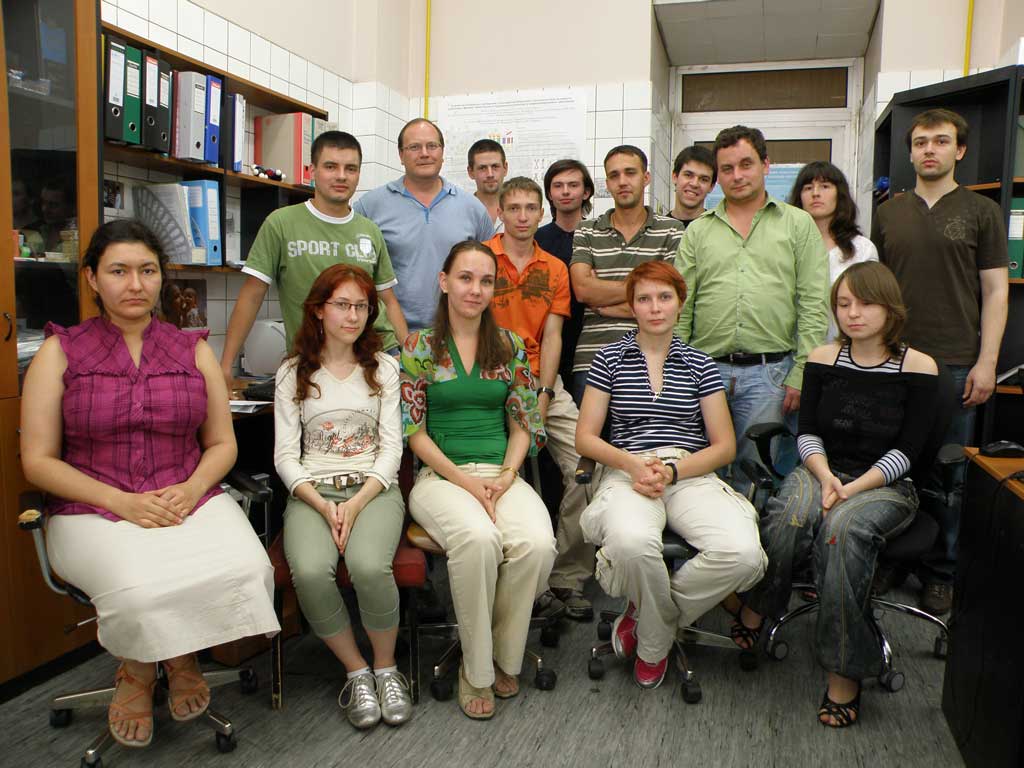
Alexander S. Arseniev

Selected publications

  1. Shenkarev Z.O., Finkina E.I., Nurmukhamedova E.K., Balandin S.V., Mineev K.S., Nadezhdin K.D., Yakimenko Z.A., Tagaev A.A., Temirov Y.V., Arseniev A.S., Ovchinnikova T.V. (2010). Isolation, structure elucidation, and synergistic antibacterial activity of a novel two-component lantibiotic lichenicidin from Bacillus licheniformis VK21. Biochemistry 49 (30), 6462–72 [+]

    A novel synergetic lantibiotic pair, Lchalpha(3249.51 Da) and Lchbeta(3019.36 Da), termed lichenicidin VK21, was isolated from the producer strain Bacillus licheniformis VK21. Chemical and spatial structures of Lchalphaand Lchbeta were determined. Each peptide contains 31 amino acid residues linked by 4 intramolecular thioether bridges and the N-terminal 2-oxobutyryl group. Spatial structures of Lchalpha and Lchbetawere studied by NMR spectroscopy in methanol solution. Lchalpha peptide displays structural homology with mersacidin-like lantibiotics and involves relatively well-structured N- and C-terminal domains connected by a flexible loop stabilized by thioether bridge Ala11-S-Ala21. In contrast, the Lchbetapeptide represents prolonged hydrophobic alpha-helix flanked with more flexible N- and C-terminal domains. A lantibiotic cluster of the Bacillus licheniformis VK21 genome which comprises the structural genes, lchA1 and lchA2, encoding the lantibiotics precursors, as well as the gene of a modifying enzyme lchM1, was amplified and sequenced. The mature peptides, Lchalphaand Lchbetainteract synergistically to possess antibiotic activity against Gram-positive bacteria within a nanomolar concentration range, though the individual peptides were shown to be active at micromolar concentrations. Our results afford molecular insight into mechanism of lichenicidin VK21 action.

  2. Mineev K.S., Bocharov E.V., Pustovalova Y.E., Bocharova O.V., Chupin V.V., Arseniev A.S. (2010). Spatial Structure of the Transmembrane Domain Heterodimer of ErbB1 and ErbB2 Receptor Tyrosine Kinases. J. Mol. Biol. 400 (2), 231–243 [+]

    Growth factor receptor tyrosine kinases of the ErbB family play a significant role in vital cellular processes and various cancers. During signal transduction across plasma membrane, ErbB receptors are involved in lateral homodimerization and heterodimerization with proper assembly of their extracellular single-span transmembrane (TM) and cytoplasmic domains. The ErbB1/ErbB2 heterodimer appears to be the strongest and most potent inducer of cellular transformation and mitogenic signaling compared to other ErbB homodimers and heterodimers. Spatial structure of the heterodimeric complex formed by TM domains of ErbB1 and ErbB2 receptors embedded into lipid bicelles was obtained by solution NMR. The ErbB1 and ErbB2 TM domains associate in a right-handed alpha-helical bundle through their N-terminal double GG4-like motif T(648)G(649)X(2)G(652)A(653) and glycine zipper motif T(652)X(3)S(656)X(3)G(660), respectively. The described heterodimer conformation is believed to support the juxtamembrane and kinase domain configuration corresponding to the receptor active state. The capability for multiple polar interactions, along with hydrogen bonding between TM segments, correlates with the observed highest affinity of the ErbB1/ErbB2 heterodimer, implying an important contribution of the TM helix-helix interaction to signal transduction.

  3. Bocharov E.V., Mayzel M.L., Volynsky P.E., Mineev K.S., Tkach E.N., Ermolyuk Y.S., Schulga A.A., Efremov R.G., Arseniev A.S. (2010). Left-handed dimer of EphA2 transmembrane domain: Helix packing diversity among receptor tyrosine kinases. Biophys. J. 98 (5), 881–9 [+]

    The Eph receptor tyrosine kinases and their membrane-bound ephrin ligands control a diverse array of cell-cell interactions in the developing and adult organisms. During signal transduction across plasma membrane, Eph receptors, like other receptor tyrosine kinases, are involved in lateral dimerization and subsequent oligomerization presumably with proper assembly of their single-span transmembrane domains. Spatial structure of dimeric transmembrane domain of EphA2 receptor embedded into lipid bicelle was obtained by solution NMR, showing a left-handed parallel packing of the transmembrane helices (535-559)(2). The helices interact through the extended heptad repeat motif L(535)X(3)G(539)X(2)A(542)X(3)V(546)X(2)L(549) assisted by intermolecular stacking interactions of aromatic rings of (FF(557))(2), whereas the characteristic tandem GG4-like motif A(536)X(3)G(540)X(3)G(544) is not used, enabling another mode of helix-helix association. Importantly, a similar motif AX(3)GX(3)G as was found is responsible for right-handed dimerization of transmembrane domain of the EphA1 receptor. These findings serve as an instructive example of the diversity of transmembrane domain formation within the same family of protein kinases and seem to favor the assumption that the so-called rotation-coupled activation mechanism may take place during the Eph receptor signaling. A possible role of membrane lipid rafts in relation to Eph transmembrane domain oligomerization and Eph signal transduction was also discussed.

  4. Goncharuk S.A., Shulga A.A., Ermolyuk Y.S., Kuzmichev P.K., Sobol V.A., Bocharov E.V., Chupin V.V., Arseniev A.S., Kirpichnikov M.P. (2009). Bacterial synthesis, purification, and solubilization of membrane protein KCNE3, a regulator of voltage-gated potassium channels. Biochemistry Mosc. 74 (12), 1344–9 [+]

    An efficient method is described for production of membrane protein KCNE3 and its isotope labeled derivatives ((15)N-, (15)N-/13C-) in amounts sufficient for structural-functional investigations. The purified protein preparation within different detergent micelles was characterized using dynamic light scattering, CD spectroscopy, and NMR spectroscopy. It is shown that within DPC/LDAO micelles the protein is in monomeric form and acquires mainly alpha-helical conformation. The existence of cross-peaks for all glycines of the (15)N-HSQC NMR spectra as well as relatively small line widths (~20 Hz) confirm the high quality of the preparation and the possibility of obtaining structural-dynamic information on KCNE3 by high resolution heteronuclear NMR spectroscopy.

  5. Krabben L., vanRossum B.J., Jehle S., Bocharov E., Lyukmanova E.N., Schulga A.A., Arseniev A., Hucho F., Oschkinat H. (2009). Loop 3 of short neurotoxin II is an additional interaction site with membrane-bound nicotinic acetylcholine receptor as detected by solid-state NMR spectroscopy. J. Mol. Biol. 390 (4), 662–71 [+]

    The contact area of neurotoxin II from Naja naja oxiana when interacting with the membrane-bound nicotinic acetylcholine receptor from Torpedo californica was determined by solid-state, magic-angle spinning NMR spectroscopy. For this purpose, the carbon signals for more than 90% of the residues of the bound neurotoxin were assigned. Differences between the solution and solid-state chemical shifts of the free and bound form of the toxin are confined to distinct surface regions. Loop II of the short toxin was identified as the main interaction site. In addition, loop III of neurotoxin II shows several strong responses defining an additional interaction site. A comparison with the structures of alpha-cobratoxin bound to the acetylcholine-binding protein from snail species Lymnaea stagnalis and Aplysia californica, and of alpha-bungarotoxin bound to an extracellular domain of an alpha-subunit of the receptor reveals different contact areas for long and short alpha-neurotoxins.

  6. Polyansky A.A., Volynsky P.E., Arseniev A.S., Efremov R.G. (2009). Adaptation of a membrane-active peptide to heterogeneous environment. I. Structural plasticity of the peptide. The journal of physical chemistry. B 113 (4), 1107–19 [+]

    A detailed study of different factors determining interaction of a membrane-active peptide (a cell-penetrating peptide — penetratin) is presented. It concerns the role of conformational plasticity of the peptide in different membrane environment, as well as the ability of the peptide to form stable specific residue-residue interactions and make contacts with particular lipids.

  7. Polyansky A.A., Volynsky P.E., Arseniev A.S., Efremov R.G. (2009). Adaptation of a membrane-active peptide to heterogeneous environment. II. The role of mosaic nature of the membrane surface. The journal of physical chemistry. B 113 (4), 1120–6 [+]

    This study postulates the mosaic hydrophobic-hydrophilic organization of the lipid membrane surface. Special attention is given to the influence of such heterogeneous polar properties of the water-lipid interface on the binding mode of membrane-active agents (a case study of cell-penetrating peptide — penetratin).

  8. Dubovskii P.V., Volynsky P.E., Polyansky A.A., Karpunin D.V., Chupin V.V., Efremov R.G., Arseniev A.S. (2008). Three-dimensional structure/hydrophobicity of latarcins specifies their mode of membrane activity. Biochemistry 47 (11), 3525–33 [+]

    Latarcins, linear peptides from the Lachesana tarabaevi spider venom, exhibit a broad-spectrum antimicrobial activity, likely acting on the bacterial cytoplasmic membrane. We study their spatial structures and interaction with model membranes by a combination of experimental and theoretical methods to reveal the structure-activity relationship. In this work, a 26 amino acid peptide, Ltc1, was investigated. Its spatial structure in detergent micelles was determined by (1)H nuclear magnetic resonance (NMR) and refined by Monte Carlo simulations in an implicit water-octanol slab. The Ltc1 molecule was found to form a straight uninterrupted amphiphilic helix comprising 8-23 residues. A dye-leakage fluorescent assay and (31)P NMR spectroscopy established that the peptide does not induce the release of fluorescent marker nor deteriorate the bilayer structure of the membranes. The voltage-clamp technique showed that Ltc1 induces the current fluctuations through planar membranes when the sign of the applied potential coincides with the one across the bacterial inner membrane. This implies that Ltc1 acts on the membranes via a specific mechanism, which is different from the carpet mode demonstrated by another latarcin, Ltc2a, featuring a helix-hinge-helix structure with a hydrophobicity gradient along the peptide chain. In contrast, the hydrophobic surface of the Ltc1 helix is narrow-shaped and extends with no gradient along the axis. We have also disclosed a number of peptides, structurally homologous to Ltc1 and exhibiting similar membrane activity. This indicates that the hydrophobic pattern of the Ltc1 helix and related antimicrobial peptides specifies their activity mechanism. The latter assumes the formation of variable-sized lesions, which depend upon the potential across the membrane.

  9. Bocharov E.V., Mineev K.S., Volynsky P.E., Ermolyuk Y.S., Tkach E.N., Sobol A.G., Chupin V.V., Kirpichnikov M.P., Efremov R.G., Arseniev A.S. (2008). Spatial structure of the dimeric transmembrane domain of the growth factor receptor ErbB2 presumably corresponding to the receptor active state. J. Biol. Chem. 283 (11), 6950–6 [+]

    Proper lateral dimerization of the transmembrane domains of receptor tyrosine kinases is required for biochemical signal transduction across the plasma membrane. The spatial structure of the dimeric transmembrane domain of the growth factor receptor ErbB2 embedded into lipid bicelles was obtained by solution NMR, followed by molecular dynamics relaxation in an explicit lipid bilayer. ErbB2 transmembrane segments associate in a right-handed alpha-helical bundle through the N-terminal tandem GG4-like motif Thr652-X3-Ser656-X3-Gly660, providing an explanation for the pathogenic power of some oncogenic mutations.

  10. Vereshaga Y.A., Volynsky P.E., Pustovalova J.E., Nolde D.E., Arseniev A.S., Efremov R.G. (2007). Specificity of helix packing in transmembrane dimer of the cell death factor BNIP3: a molecular modeling study. Proteins 69 (2), 309–25 [+]

    A computational technique for prediction of the spatial structure of transmembrane alpha-helical dimers is proposed. The approach is based on Monte Carlo simulations in the space of dihedral angles in the presence of the implicit membrane. Validity of the method was demonstrated with the example of transmembrane domain of mitochondrial pro-apoptotic protein BNIP3.

  11. Chugunov A.O., Novoseletsky V.N., Nolde D.E., Arseniev A.S., Efremov R.G. (2007). Method to assess packing quality of transmembrane alpha-helices in proteins. 1. Parametrization using structural data. Journal of chemical information and modeling 47 (3), 1150–62 [+]

    Integral membrane proteins (MPs) are pharmaceutical targets of exceptional importance. Modern methods of three-dimensional protein structure determination often fail to supply the fast growing field of structure-based drug design with the requested MPs' structures. That is why computational modeling techniques gain a special importance for these objects. Among the principal difficulties limiting application of these methods is the low quality of the MPs' models built in silico. In this series of two papers we present a computational approach to the assessment of the packing "quality" of transmembrane (TM) alpha-helical domains in proteins. The method is based on the concept of protein environment classes, whereby each amino acid residue is described in terms of its environment polarity and accessibility to the membrane. In the first paper we analyze a nonredundant set of 26 TM alpha-helical domains and compute the residues' propensities to five predefined classes of membrane-protein environments. Here we evaluate the proposed approach only by various test sets, cross-validation protocols and ability of the method to delimit the crystal structure of visual rhodopsin, and a number of its erroneous theoretical models. More advanced validation of the method is given in the second article of this series. We assume that the developed "membrane score" method will be helpful in optimizing computer models of TM domains of MPs, especially G-protein coupled receptors.

  12. Chugunov A.O., Novoseletsky V.N., Nolde D.E., Arseniev A.S., Efremov R.G. (2007). Method to assess packing quality of transmembrane alpha-helices in proteins. 2. Validation by "correct vs misleading" test. Journal of chemical information and modeling 47 (3), 1163–70 [+]

    We describe a set of tests designed to check the ability of the new "membrane score" method (see the first paper of this series) to assess the packing quality of transmembrane (TM) alpha-helical domains in proteins. The following issues were addressed: (1) Whether there is a relation between the score (S(mem)) of a model and its closeness to the "nativelike" conformation? (2) Is it possible to recognize a correct model among misfolded and erroneous ones? (3) To what extent the score of a homology-built model is sensitive to errors in sequence alignment? To answer the first question, two test cases were considered: (i) Several models of bovine aquaporin-1 (target protein) were built on the structural templates provided by its homologs with known X-ray structure. (ii) Side chains in the spatial models of visual rhodopsin and cytochrome c oxidase were rebuilt based on the backbone scaffolds taken from their crystal structures, and the resulting models were iteratively fitted into the full-atom X-ray conformations. It was shown that the higher the S(mem) value of a model is, the lower its root-mean-square deviation is from the "correct" (crystal) structure of a target. Furthermore, the "membrane score" method successfully identifies the rhodopsin crystal structure in an ensemble of "rotamer-type" decoys, thus providing the way to optimize mutual orientations of alpha-helices in models of TM domains. Finally, being applied to a set of homology models of rhodopsin built on its crystal structure with systematically shifted alignment, the approach demonstrates a prominent ability to detect alignment errors. We therefore assume that the "membrane score" method will be helpful in optimization of in silico models of TM domains in proteins, especially those in GPCRs.

  13. Chugunov A.O., Novoseletsky V.N., Arseniev A.S., Efremov R.G. (2007). A novel method for packing quality assessment of transmembrane alpha-helical domains in proteins. Biochemistry Mosc. 72 (3), 293–300 [+]

    Here we present a novel method for assessment of packing quality for transmembrane (TM) domains of alpha-helical membrane proteins (MPs), based on analysis of available high-resolution experimental structures of MPs. The presented concept of protein-membrane environment classes permits quantitative description of packing characteristics in terms of membrane accessibility and polarity of the nearest protein groups. We demonstrate that the method allows identification of native-like conformations among the large set of theoretical MP models. The developed "membrane scoring function" will be of use for optimization of TM domain packing in theoretical models of MPs, first of all G-protein coupled receptors.

  14. Pyrkov T.V., Kosinsky Y.A., Arseniev A.S., Priestle J.P., Jacoby E., Efremov R.G. (2007). Complementarity of hydrophobic properties in ATP-protein binding: a new criterion to rank docking solutions. Proteins 66 (2), 388–98 [+]

    Analysis of X-ray structures of ATP-protein complexes was carried out to reveal the major determinants of adenin recognition by proteins. We demonstrated that hydrophobic contacts and stacking play the main role here. Efficient adenin-specific scoring function was proposed to filter the results of molecular docking.

  15. Efremov R.G., Chugunov A.O., Pyrkov T.V., Priestle J.P., Arseniev A.S., Jacoby E. (2007). Molecular lipophilicity in protein modeling and drug design. Curr. Med. Chem. 14 (4), 393–415 [+]

    Hydrophobic interactions play a key role in the folding and maintenance of the 3-dimensional structure of proteins, as well as in the binding of ligands (e.g. drugs) to protein targets. Therefore, quantitative assessment of spatial hydrophobic (lipophilic) properties of these molecules is indispensable for the development of efficient computational methods in drug design. One possible solution to the problem lies in application of a concept of the 3-dimensional molecular hydrophobicity potential (MHP). The formalism of MHP utilizes a set of atomic physicochemical parameters evaluated from octanol-water partition coefficients (log P) of numerous chemical compounds. It permits detailed assessment of the hydrophobic and/or hydrophilic properties of various parts of molecules and may be useful in analysis of protein-protein and protein-ligand interactions. This review surveys recent applications of MHP-based techniques to a number of biologically relevant tasks. Among them are: (i) Detailed assessment of hydrophobic/hydrophilic organization of proteins; (ii) Application of this data to the modeling of structure, dynamics, and function of globular and membrane proteins, membrane-active peptides, etc. (iii) Employment of the MHP-based criteria in docking simulations for ligands binding to receptors. It is demonstrated that the application of the MHP-based techniques in combination with other molecular modeling tools (e.g. Monte Carlo and molecular dynamics simulations, docking, etc.) permits significant improvement to the standard computational approaches, provides additional important insights into the intimate molecular mechanisms driving protein assembling in water and in biological membranes, and helps in the computer-aided drug discovery process.

  16. Volynsky P.E., Bocharov E.V., Nolde D.E., Vereshaga Y.A., Mayzel M.L., Mineev K.S., Mineeva E.V., Pustovalova Yu.E., Gagnidze I.A., Efremov R.G., Arseniev A.S. (2006). Solution of the Spatial Structure of Dimeric Transmembrane Domains of Proteins by Heteronuclear NMR Spectroscopy and Molecular Modeling. Biophysics 51 (S1), S23–S27 [+]

    Membrane proteins play an important role in various biological processes. An approach combining
    NMR spectroscopy with molecular modeling was used to study the spatial structure and intramolecular dynamics of protein transmembrane domains consisting of two interacting α-helices. The approach was tested with model transmembrane domains and yielded detailed atomic-level data on the protein–protein and protein–lipid interactions.

  17. Kasheverov I.E., Chiara D.C., Zhmak M.N., Maslennikov I.V., Pashkov V.S., Arseniev A.S., Utkin Y.N., Cohen J.B., Tsetlin V.I. (2006). alpha-Conotoxin GI benzoylphenylalanine derivatives. (1)H-NMR structures and photoaffinity labeling of the Torpedo californica nicotinic acetylcholine receptor. FEBS J. 273 (7), 1373–88 [+]

    alpha-Conotoxins are small peptides from cone snail venoms that function as nicotinic acetylcholine receptor (nAChR)-competitive antagonists differentiating between nAChR subtypes. Current understanding about the mechanism of these selective interactions is based largely on mutational analyses, which identify amino acids in the toxin and nAChR that determine the energetics of ligand binding. To identify regions of the nAChR involved in alpha-conotoxin binding by use of photoactivated cross-linking, two benzoylphenylalanine (Bpa) analogs of alpha-conotoxin GI, GI(Bpa12) and GI(Bpa4), were synthesized by replacing the respective residues with Bpa, and their (1)H-NMR structures were determined.

  18. Feofanov A.V., Sharonov G.V., Astapova M.V., Rodionov D.I., Utkin Y.N., Arseniev A.S. (2005). Cancer cell injury by cytotoxins from cobra venom is mediated through lysosomal damage. Biochem. J. 390 (Pt 1), 11–8 [+]

    Cytotoxins from cobra venom are known to manifest cytotoxicity in various cell types. It is widely accepted that the plasma membrane is a target of cytotoxins, but the mechanism of their action remains obscure. Using the confocal spectral imaging technique, we show for the first time that cytotoxins from cobra venom penetrate readily into living cancer cells and accumulate markedly in lysosomes. Cytotoxins CT1 and CT2 from Naja oxiana, CT3 from Naja kaouthia and CT1 from Naja haje are demonstrated to possess this property with respect to human lung adenocarcinoma A549 and promyelocytic leukaemia HL60 cells. Immobilized plasma membrane binding accompanies the internalization of CT3 from Naja kaouthia in the HL60 cells, but it is very weak for other cytotoxins. Detectable membrane binding is not a property of any of the cytotoxins tested in A549 cells. The kinetics and concentration-dependence of cytotoxin accumulation in lysosomes correlate well with their cytotoxic effects. On the basis of the results obtained, we propose that lysosomes are a primary target of the lytic action of cytotoxins. Plasma membrane permeabilization seems to be a downstream event relative to lysosome rupture. Direct damage to the plasma membrane may be a complementary mechanism, but its relative contribution to the cytotoxic action depends on the cytotoxin structure and cell type.

  19. Sharonov G.V., Feofanov A.V., Bocharova O.V., Astapova M.V., Dedukhova V.I., Chernyak B.V., Dolgikh D.A., Arseniev A.S., Skulachev V.P., Kirpichnikov M.P. (2005). Comparative analysis of proapoptotic activity of cytochrome c mutants in living cells. Apoptosis 10 (4), 797–808 [+]

    A non-traumatic electroporation procedure was developed to load exogenous cytochrome c into the cytoplasm and to study the apoptotic effect of cytochrome c, its K72-substitued mutants and "yeast --> horse" hybrid cytochrome c in living WEHI-3 cells. The minimum apoptosis-activating intracellular concentration of horse heart cytochrome c was estimated to be 2.7 +/- 0.5 microM (47 +/- 9 fg/cell). The equieffective concentrations of the K72A-, K72E- and K72L-substituted mutants of cytochrome c were five-, 15- and 70-fold higher. The "yeast --> horse" hybrid created by introducing S2D, K4E, A7K, T8K, and K11V substitutions (horse protein numbering) and deleting five N-terminal residues in yeast cytochrome c did not evoke apoptotic activity in mammalian cells. The apoptotic function of cytochrome c was abolished by the K72W substitution. The K72W-substituted cytochrome c possesses reduced affinity to the apoptotic protease activating factor-1 (Apaf-1) and forms an inactive complex. This mutant is competent as a respiratory-chain electron carrier and well suited for knock-in studies of cytochrome c-mediated apoptosis.

  20. Korolkova Y.V., Bocharov E.V., Angelo K., Maslennikov I.V., Grinenko O.V., Lipkin A.V., Nosyreva E.D., Pluzhnikov K.A., Olesen S.P., Arseniev A.S., Grishin E.V. (2002). New binding site on common molecular scaffold provides HERG channel specificity of scorpion toxin BeKm-1. J. Biol. Chem. 277 (45), 43104–9 [+]

    The scorpion toxin BeKm-1 is unique among a variety of known short scorpion toxins affecting potassium channels in its selective action on ether-a-go-go-related gene (ERG)-type channels. BeKm-1 shares the common molecular scaffold with other short scorpion toxins. The toxin spatial structure resolved by NMR consists of a short alpha-helix and a triple-stranded antiparallel beta-sheet. By toxin mutagenesis study we identified the residues that are important for the binding of BeKm-1 to the human ERG K+ (HERG) channel. The most critical residues (Tyr-11, Lys-18, Arg-20, Lys-23) are located in the alpha-helix and following loop whereas the "traditional" functional site of other short scorpion toxins is formed by residues from the beta-sheet. Thus the unique location of the binding site of BeKm-1 provides its specificity toward the HERG channel.

  21. Efremov R.G., Nolde D.E., Vergoten G., Arseniev A.S. (1999). A solvent model for simulations of peptides in bilayers. I. Membrane-promoting alpha-helix formation. Biophys. J. 76 (5), 2448–59 [+]

    A novel model of implicit membrane was proposed. The efficiency of the model in prediction of alpha-helical content of several homopolypeptides (poly-Leu, poly-Val, poly-Leu, poly-Gly) was proofed by series of Monte-Carlo simulations.

  22. Arseniev A.S., Bystrov V.F., Lomize A.L., Ovchinnikov Yu.A. (1985). 1H-NMR study of gramicidin A transmembrane ion channel. Head-to-head right-handed, single-stranded helices. FEBS Lett. 186 (2), 168–174 [+]

    The structure of [Val1] gramicidin A incorporated into sodium dodecyl-d25 sulphate micelles has been studied by two-dimensional proton NMR spectroscopy. Analysis of nuclear Overhauser effects, spin-spin couplings and solvent accessibility of NH groups show that the conformation of the Na+ complex of gramicidin A in detergent micelles, which in many ways mimic the phospholipid bilayer of biomembranes, is an N-terminal to N-terminal (head-to-head) dimer Image formed by two right-handed, single-stranded β6.3 helices with 6.3 residues per turn, differing from Urry's structure by handedness of the helices.