


Press-room / news / Science news /
An “Ancient” Frog Gene Accelerates Skin Wound Healing in Mice
Researchers from the Department of Genomics and Postgenomic Technologies at the State Research Center Institute of Bioorganic Chemistry of the Russian Academy of Sciences and the Department of Regenerative Medicine at Pirogov Russian National Research Medical University have shown that the ag1 gene, an important regulator of regeneration in amphibians that was lost in all amniotes, including reptiles, birds, and mammals, during evolution, can accelerate skin wound healing when introduced into the mouse genome. Activation of this gene in transgenic mice was found to trigger molecular programs associated with regeneration-biased and scar- reduced tissue repair. These findings open new perspectives for fundamental research in tissue regeneration and repair. The results are published in Frontiers in Cell and Developmental Biology.
During vertebrate evolution, many animals lost the ability to fully regenerate tissues. Fish and amphibians are capable of regenerating limbs and healing wounds without scarring, whereas in amniotes such processes are strongly limited and almost always accompanied by scar formation. One reason for this difference is the evolutionary loss of a number of genes that participated in regenerative programs in the common ancestors of modern vertebrates.
In the present study, the authors demonstrate that a regeneration-associated gene lost by amniotes hundreds of millions of years ago can still influence tissue repair processes. They show that activation of the ag1 gene, which has been preserved in amphibians, accelerates skin wound healing in laboratory mice and alters the molecular programs underlying skin repair.
The ag1 gene is known as one of the regulators of regeneration in fish and amphibians, organisms capable of scar-free wound healing and limb regeneration. This gene is absent in amniotes, including reptiles, birds, and mammals. To investigate its potential role, the researchers generated a transgenic mouse model with inducible expression of the ag1 gene from the frog Xenopus laevis.
The experiments demonstrated that activation of ag1 accelerated skin wound closure in mice by approximately 20%. Particularly informative results were obtained from transcriptomic analysis of healing skin. Activation of ag1 led to increased expression of a broad set of genes associated with regeneration-biased and scar-reduced healing, including genes encoding Collagen III, TGF-β3, and other molecular markers previously linked to scar-free repair in amphibians and mammalian fetuses.
At the same time, wound healing in adult mice did not become fully “embryonic”. Genes associated with scar formation were activated alongside regenerative genes. This indicates the induction of a hybrid repair program that combines regenerative and fibrotic mechanisms rather than a complete reversion to fetal-type healing.
The authors emphasize that this study is of a fundamental nature. Nevertheless, the results demonstrate that genes lost during evolution can remain functionally compatible with the molecular networks of mammals and can modulate reparative processes when reactivated. In the long term, these findings open new directions for research in regenerative biology and medicine, ranging from improved wound healing to strategies aimed at limiting pathological fibrosis.
ranging from improved wound healing to strategies aimed at limiting pathological fibrosis. This work was carried out within the framework of the state assignment no. 124021000001-9 and supported by the Russian Science Foundation (grant no. 23-74-30005).
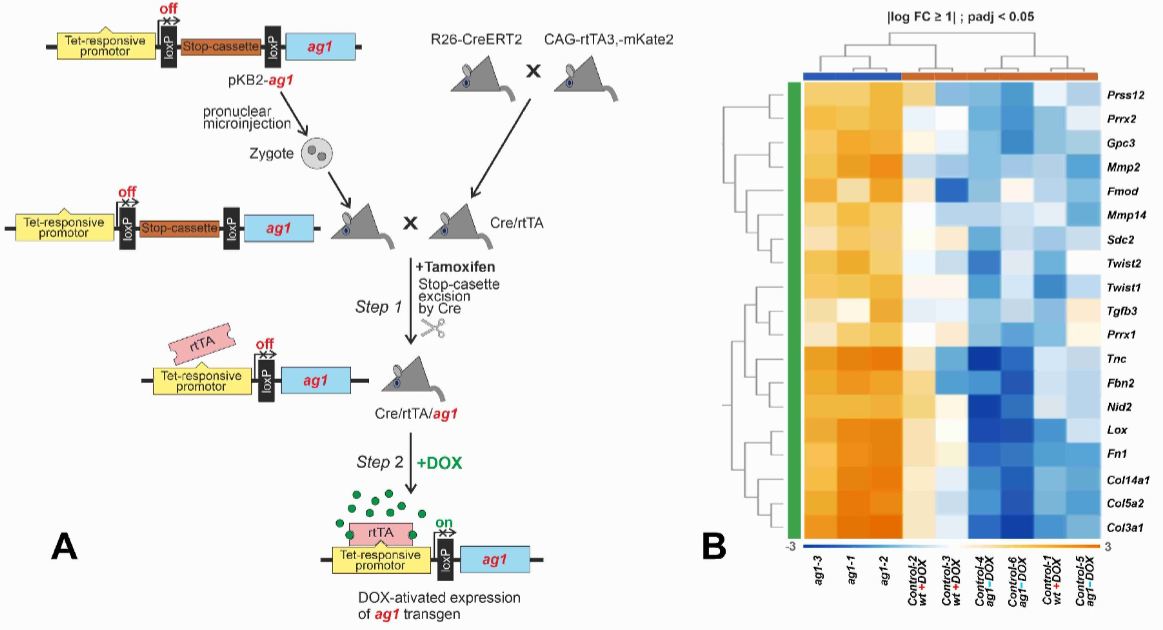
Figure 1. Generation of ag1-transgenic mice and activation of regeneration-associated gene programs during skin wound healing.
(A) Schematic representation of the generation of the transgenic mouse line and induction of expression of the ag1 gene from the African clawed frog Xenopus laevis.
(B) Heatmap showing activation of a set of genes characteristic of scar-reduced skin healing in mouse embryos during skin wound healing in adult ag1-transgenic mice with activated ag1 expression.
february 19