


Press-room / news / Science news /
How can plant defence responses to pathogen and pest attacks be observed?
Scientists from the Department of Biomolecular Chemistry at the Shemyakin–Ovchinnikov Institute of Bioorganic Chemistry of the Russian Academy of Sciences developed autoluminescent reporters for non-invasive imaging of plant defence responses. Using consumer-grade cameras, they visualized the spatiotemporal activity of the phytohormones salicylic acid and jasmonic acid in Arabidopsis thaliana and Nicotiana benthamiana during normal development as well as in response to pest and pathogen attacks. The study was published in Nature Communications.
Researchers from the Alexander Mishin, Tatiana Mityushkina and Ilia Yampolsky laboratories at the Shemyakin–Ovchinnikov Institute of Bioorganic Chemistry of the Russian Academy of Sciences, working in an international collaboration, have introduced a system that makes it possible to non-invasively monitor the activity of two key plant defence signalling pathways in living plants: the salicylic acid and jasmonic acid pathways. The authors created plant lines expressing autoluminescent reporters, allowing the plant to emit light only at the time and in the tissues where defence mechanisms against pathogens and pests are activated. The work was published in Nature Communications.
The main challenge in visualizing such physiological responses is that they are complex, often context-dependent processes unfolding across space and time. To understand these processes, it is essential to see exactly where the signal arises, how rapidly it spreads, and how a local response differs from a systemic one. Conventional methods used for such studies require external illumination of plants, addition of luciferin, or invasive sampling of material, meaning that the full picture often has to be reconstructed from fragmented measurements.
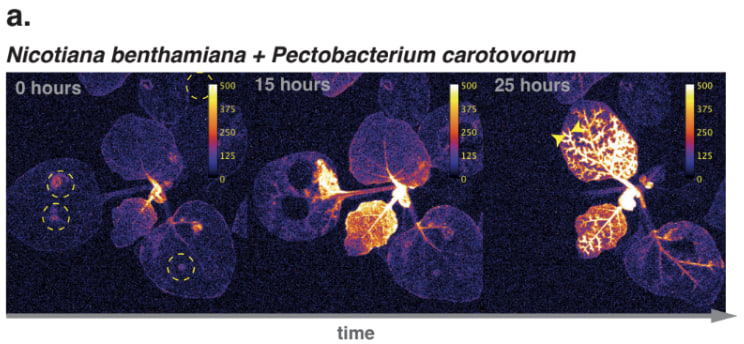
The authors showed that the new approach, based on the fungal bioluminescence system, makes it possible to observe this dynamic directly—during wounding, bacterial infection, insect pest attack, and even during normal plant development. In this sense, the work makes the development of defence responses truly observable at the level of the whole organism. Moreover, ordinary digital cameras are sufficient to record the luminescent signal.
march 18