


Press-room / news / Science news /
Glowing fungi expose final enzyme that could make bioluminescent tools more efficient
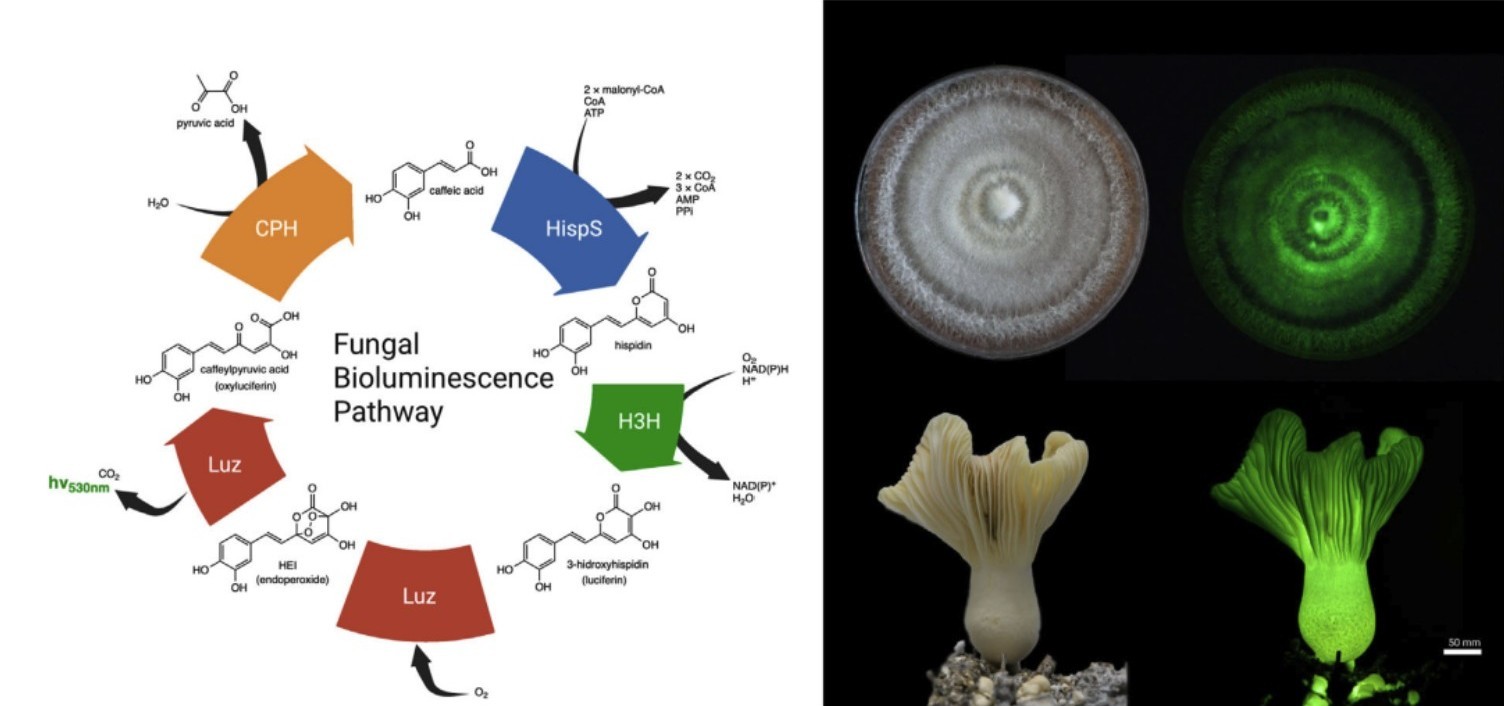
Researchers from the Department of Biomolecular Chemistry at the Shemyakin- Ovchinnikov Institute of Bioorganic Chemistry together with international collaborators published two papers in The FEBS Journal confirming the role of the CPH enzyme in the fungal bioluminescence pathway: it breaks down oxyluciferin into caffeic and pyruvic acids, helping sustain light emission by recycling caffeic acid back into the bioluminescent system, while pyruvic acid may be redirected into central metabolism to help generate cellular energy. The findings open up opportunities for developing more efficient autonomous bioluminescent systems for medicine, biotechnology, agriculture, and environmental monitoring.
Like fireflies and many deep-sea creatures, certain fungi can naturally emit light through bioluminescence pathways in which specialized enzymes convert chemical energy into visible light. Medical researchers have used fungal light-producing enzymes in the fungal bioluminescence pathway (FBP) to visually track processes like tumor progression and inflammatory responses. Two new research articles published in The FEBS Journal (1, 2) provide insights that may help improve and expand such bioluminescence-based tools and applications.
One of the products of the FBP is oxyluciferin, which in fungi is subsequently degraded and recycled back into the pathway, sustaining the bioluminescent process. Previous studies have suggested a role for the caffeylpyruvate hydrolase (CPH), the last of four enzymes involved in the FBP, in breaking down oxyluciferin, but results have been inconclusive.
In this latest study, investigators characterized CPH from one of the largest and brightest bioluminescent fungal species described to date, confirming that the enzyme converts oxyluciferin into caffeic and pyruvic acids. Caffeic acid can re-enter the pathway to sustain light emission, while pyruvic acid may be redirected into central metabolism to help generate cellular energy, potentially reducing the energetic cost of bioluminescence.
The scientists also developed a new method to monitor CPH activity, thereby providing a useful resource for further studies on bioluminescence.
The findings could be used to develop self-sustained light-emitting systems in other organisms, with potential applications across medicine, agriculture, environmental monitoring, and biotechnology.
"After eight years of work, we were finally able to demonstrate that the breakdown of fungal oxyluciferin by CPH produces caffeic acid and pyruvic acid. This finding helps explain how fungi sustain bioluminescence through metabolite recycling while potentially recovering part of the energy invested in light emission," said co-corresponding author Cassius V. Stevani, Ph.D., of the University of São Paulo, in Brazil. "It also provides important insights for the design of engineered cells capable of emitting brighter light in a more efficient and sustainable way."
The results of the study were covered by Wiley and Phys.org.
may 22